The Ghost and Mr. Chicken (1966)

From the video box:

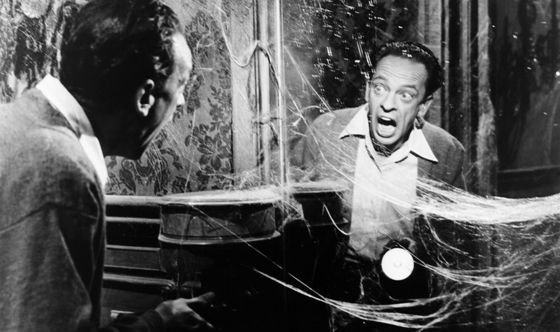
In one of his most popular films, Don Knotts stars as a newspaper typesetter whose dream of becoming a reporter materializes after he spends a night in a haunted house. (1966, color)

Mark says:

Don Knotts may have been a one-trick-pony (all of his roles seem to be a theme on Barney Fife) but he crafted the twitchy-cowardly-lovable character so well that I would have been disappointed to see him play anything else.

The Ghost and Mr. Chicken is the first film Knotts starred in after his departure from The Andy Griffith Show. He plays Luther Heggs, a newspaper typesetter with aspirations of becoming a big-time investigative reporter. Unfortunately, Luther’s aspirations far surpass his talents. He seems doomed to take taunts from not only his co-worker, Reporter Ollie Weaver (Skip Homeier), but from the general populace at large.

Luther is almost an exact replica of Barney Fife. He talks big, but is an obvious coward. He’s easily flustered, awkward with women, and ridiculed by men. He’s also completely hilarious. I love this movie today almost as much as I adored it when I was growing up.

You’ll recognize most of the characters as regular TV fixtures from the time period. Many of them even had steady roles on The Andy Griffith Show. This isn’t too surprising considering that both the credited writers (James Fritzell and Everett Greenbaum) were writers for Andy Griffith. In fact, though not credited, Mr. Griffith himself was brought in during the re-write.

Pretty Joan Staley plays Alma Parker, Luther’s love interest. Of course, Luther is a blundering mass of nervous energy in her presence. He also has to compete for her affections with suave Ollie. Alma’s primary function in the film is to be sympathetic to Luther and serve as his motivation.

Liam Redmond (Curse of the Demon) plays Kelsey, Luther’s friend. Kelsey was an eyewitness to the murder-suicide that occurred at the old Simmons place (a house that looks suspiciously similar to the house in Psycho) twenty years earlier. Kelsey convinces Luther to write an article on the event and then slip it into the newspaper disguised as filler. The editor (Dick Sargent) does not read the article until after it is printed. Surprised to find that Luther is the author of the piece, he offers him a follow-up assignment: Spend the night alone at the Simmons’ house on the twentieth anniversary of the murder-suicide.

You can guess the hijinks that follow. Luther is reluctant to take the assignment, but to impress Alma, and to spite Ollie, he enters the house shortly before midnight. All sorts of spooky things happen, and Barney, er, Luther, reacts in a typically cowardly (yet determined) fashion. Amazingly, his story gets published and he becomes a local hero. Luther’s glory is short-lived, though, as Nicholas Simmons (Phil Ober) has recently returned to town to have the family house demolished. Nicholas sues Luther for slandering the Simmons name. Luther is then put in the position of having to prove the events of the night in one of the funniest courtroom scenes I have ever watched.

The Ghost and Mr. Chicken, being a comedy, really isn’t scary, but I do remember being frightened by certain scenes as a child. For example, when Luther discovers the garden shears plunged into the painting of Mrs. Simmons, the blood trickling out is surprisingly graphic. The tale of the murder-suicide itself is an unlikely background for a comedy starring Don Knotts, but it works perfectly.

Vic Mizzy composed the impressive original musical score. Even if you stripped away the dialog, the music would convey the nuances of the story. The haunted organ number is spooky, yet jaunty. Hearing the score, even after all of these years, still makes me smile.

Each scene of The Ghost and Mr. Chicken is a perfect comedic vehicle for Don Knotts. He is surrounded by a charming cast of character actors who add their own particular brand of humor to the film. Everyone from the “Psychic Occult Society of Rachel,” to the hen-pecked banker, Mr. Maxwell, is a complete delight.

Don Knotts not only allowed us to laugh at him, but he gave us an opportunity to laugh at ourselves. Men, particularly, seem to hold a fondness for this reluctant hero. He took male vulnerabilities and exaggerated them to the nth degree, and though often appearing foolish, he never lost that lovable quality. The guy had spunk.

Boy, do I miss him.

The Ghost and Mr. Chicken is directed by Alan Rafkin.

Scene to watch for: Ellen Corby (The Strangler) plays Luther’s grade school teacher, Miss Neva Tremaine, and recounts his boyhood antics for the court.

Line to listen for: “Attaboy, Luther!”

Luther’s speech: “I have been called brave. What is brave? Let me clarify this. Of course we all know this is short for brave-r-y. That goes without even being said. But it is also a symbol of another thing. It is a symbol of doing one’s duty no matter what is scaring him personally. Take your World War II. There were many heroes in World War II. What were your heroes? Who were your heroes? Let me clarify this. Thank you for having me.”

Trivia: Joan Staley (Luther’s love interest) was Playboy’s Playmate of the Month for November 1958.

Mark’s Rating! ! ! ! out of 5.

The Alligator People (1959)

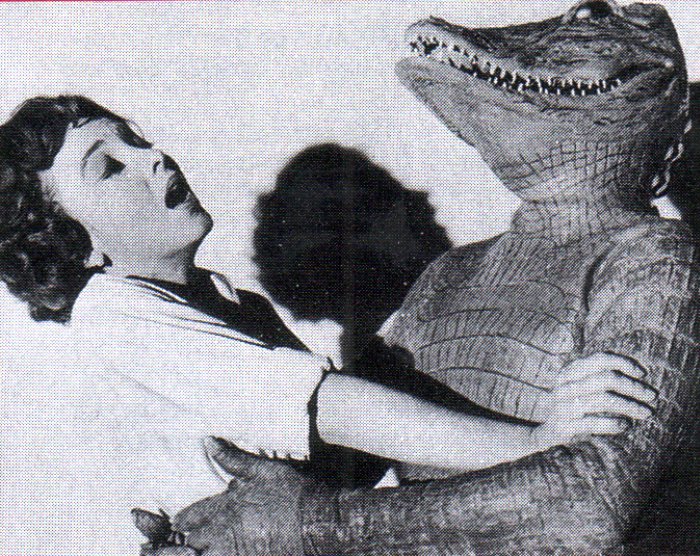
Beverly Garland wrestles with Alligator Man, Richard Crane

From the DVD case:

A young wife (Beverly Garland) is abandoned by her husband (Richard Crane) on their wedding day. Distraught, she traces him to his ancestral home in the bayous of Louisiana, where, amid the swamps and deadly undergrowth, she discovers a terrible secret.

Her husband was saved from death by an experimental medical procedure involving serum derived from alligators, and now he’s developing horrifying side effects. She’ll face any danger to help him, but soon discovers her love may not be enough. (1959,b&w)

Mark says:

When film historian Tom Weaver asked Beverly Garland about her experiences during The Alligator People, she replied, “The hardest thing in that movie was simply to keep a straight face.” That gives you an idea as to the type of movie we are dealing with here. Of course, you probably already guessed that from the title.

Most of The Alligator People is told in flashback. A psychiatrist, Dr. MacGregor (Douglas Kennedy; The Amazing Transparent Man) discovers that his nurse has suffered a traumatic shock that she can only remember through hypnosis. The nurse, played by Beverly Garland (It Conquered the World) has taken on a new identity since the trauma, completely repressing the events that led to her breakdown. The story unfolds through Garland’s narrative while under hypnosis.

Beverly Garland is not just window dressing to support a leading man, but the true star of this picture. She plays Jane Marvin, who, before her trauma, was known as Joyce Webster. Because most of the story takes place in the past, I will refer to Garland’s character as Joyce for the remainder of this review.

Joyce is a determined woman who tenaciously tracks her husband after he disappears from a train during their wedding night. She finally traces him to an old plantation in Louisiana, where she faces down Mrs. Hawthorne (Frieda Inescort, The She-Creature) an old ogress and “lady” of the house. Mrs. Hawthorne is obviously eager to get rid of Joyce, and claims no knowledge of her bridegroom. Mrs. Hawthorne reveals a secret about her identity later in the film (which I won’t reveal as it is probably the only source of suspense you’ll find here).

Richard Crane (House of the Damned) plays Joyce’s husband, Paul Webster, who, because of an experimental new medication, is transforming into an alligator man. Crane’s performance isn’t particularly noteworthy, but it is fun to listen to him speak like an alligator. Mr. Webster is only one of many alligator people being treated at the remote Louisiana facility. Of course, all of this is supposed to be hush-hush, and Joyce’s arrival compromises their security.

The inventor of the alligator serum is Dr. Sinclair, played by George Macready (years later he narrated Count Yorga, Vampire). Dr. Sinclair’s intentions were noble enough. He simply wanted to use the healing properties of alligator hormones to restore those who have been badly injured, crushed, or burned. Unfortunately, the serum not only heals people, it gives them scales and funny voices. Dr. Sinclair desperately searches for a method to undo his damage.

The most colorful character is Manon, played by horror legend Lon Chaney (The Wolf ManThe Mummy’s Tomb). Manon is a drunken hired hand who hates “gators” ever since losing a hand to one. Chaney genuinely seems to enjoy his role and hams it up like only an old horror star can. You can’t help but be amused when he disgustedly spits out lines like, “Dirty, stinkin’, slimy gators! ” Manon spends his free time shooting the reptiles and vows to “never stop killin’ gators,” which is bad news for alligator people.

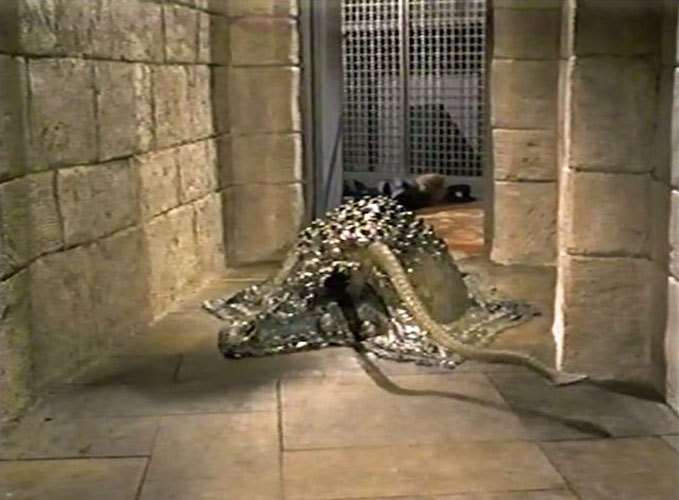
One of the many flaws of The Alligator People is that the alligator men don’t pose any real threat. They are alligators only in appearance. Joyce’s husband possess all of his human faculties even when in advanced stages. He even plays the piano, though he does leave the keys wet and tracks muddy footprints on the carpet, the beast.

The make-up, though not bad while the alligator people are in mid-transformation, becomes ridiculous when the metamorphosis is complete. Just look at the image above and you’ll understand why Miss Garland had such a hard time keeping a straight face throughout this picture.

Though The Alligator People is primarily pure camp fodder, it still has the virtue of being entertaining. Garland’s portrayal of an able-bodied nurse (she not only faces down slimy gators, but takes a punch from Chaney, too) gives the story some creditability.

I can’t recommend The Alligator People as a vehicle for suspense and thrills, but I definitely recommend it as a source of kitschy fun.

Directed by Roy Del Ruth (Phantom of the Rue Morgue).

Scene to watch for: Beverly Garland finds a crate labeled, “Caution: Radioactive Material,” and promptly sits down on it.

Line to listen for: “I’ll kill you Alligator Man! Just like I’d kill any four-legged gator!”

Mark’s Rating! ! ! out of 5.

The Manster (1959)


From the DVD case
:

An American reporter is sent to interview a Tokyo-based scientist. The scientist goes completely mad, and while experimenting with mutations, he turns the reporter into a two headed monster called The Manster, half-man and half-monster. The ending is truly bizarre. (1959, b&w)

Mark says

The Manster. Even the title sounds like a joke. This American/Japanese production is just as silly as the title suggests, though it does have a few eerie moments and one unforgetable scene.

Satoshi Nakamura (The Human VapourMothra) plays Dr. Robert Suzuki, a Japanese scientist who attempts to speed up evolution to create an entirely new species of man. We learn early on that two of Dr. Suzuki’s experiments have failed miserably. His first experiment on his wife, Emiko (Toyoko Takechi), resulted in half of her face practically drooping off. This is actually a disturbing sight, especially in combination with her constant groaning and screaming. Emiko, reduced to the status of a grotesque beast, is kept in a cage in the doctor’s lab.

The movie begins with Suzuki’s second failure. His brother is transformed into a murderous ape-like creature after an injection, and Dr. Suzuki is forced to kill him to stop his bloody rampage.

Apparently, Dr. Suzuki feels the third time is a charm. When American reporter, Larry Stanford, played by British actor, Peter Dyneley (House of Mystery), arrives to interview him, Dr. Suzuki secretly injects Larry with his new and improved serum. The movie, already bizarre, takes an even more absurd twist after Larry’s injection.

Larry is rather likable before the injection. He is anxious to return to New York and, after years of globe-trotting, is looking forward to finally settling down with his wife, Linda, played by Jane Hylton (Circus of HorrorsHouse of Mystery). However, post-injection Larry is nothing but a cad.

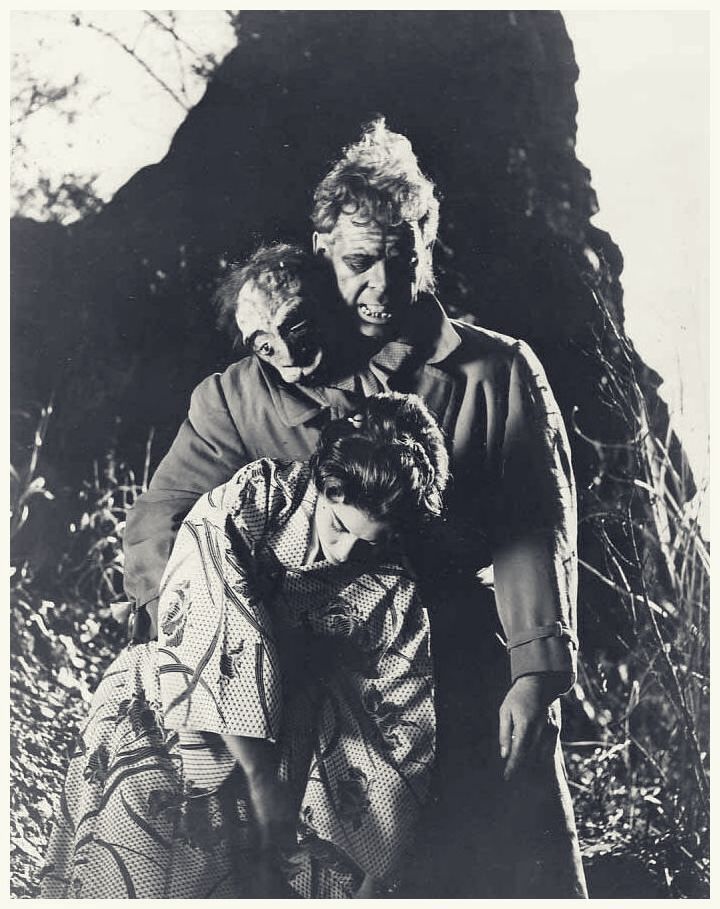
The Manster is essentially a Jekyll and Hyde story, though we see very little of the “good Larry” after the serum has been administered. As Larry sinks further into debauchery, he begins to notice physical changes. First, he experiences a lack of control of his right hand, which eventually becomes a hairy deformity. Furthermore, he suffers a constant irritation on his right shoulder, which he can’t seem to stop rubbing.

The scene everyone remembers is one in which Larry rips away his shirt to reveal an extra eyeball growing from his shoulder. It’s a strangely surreal and nightmarish image that leaves a strong impression in the mind. People who saw The Manster in their youth often remember nothing else about the movie (including its title), which is probably for the better.

Everything after the eyeball scene is anti-climatic. Larry becomes a murderous maniac (even stooping so low as to kill a Buddhist temple priest) and the extra eyeball eventually develops into a second head. That’s right; Larry becomes a two-headed monster. Have you ever seen a respectable two-headed monster movie? Me neither. The Manster is no exception.

The film ends on a philosophical note as Linda (Larry’s wife), and Larry’s editor, Ian (Norman Van Hawley), discuss the good and evil in all men. The final message seems to be that we need to have faith in the good of all men.

The Manster, though featuring a few powerful images, is an absurd movie. It is not without its kitsch appeal, but I can’t imagine anyone except hardcore B-movie fans finding this film of much interest. Even those who may recall the movie fondly from childhood (undoubtedly because of the scene with the extra eyeball) will most likely be disappointed when reviewing it as an adult.

Directed by George P. Breakston and Kenneth G. Crane (Monster from Green Hell).

Scene to watch for: There is only one scene to mention here: Larry examines his shoulder to discover that extra eyeball staring up at him.

Line to listen for: “Have faith, Linda. Have faith in the good that’s still in Larry — and in all men.”

Trivia: Larry and Linda Sanford were played by real life husband and wife Peter Dyneley and Jane Hylton. The two often appeared in plays and movies together.

Mark’s Rating! ! out of 5.

Tormented (1960)

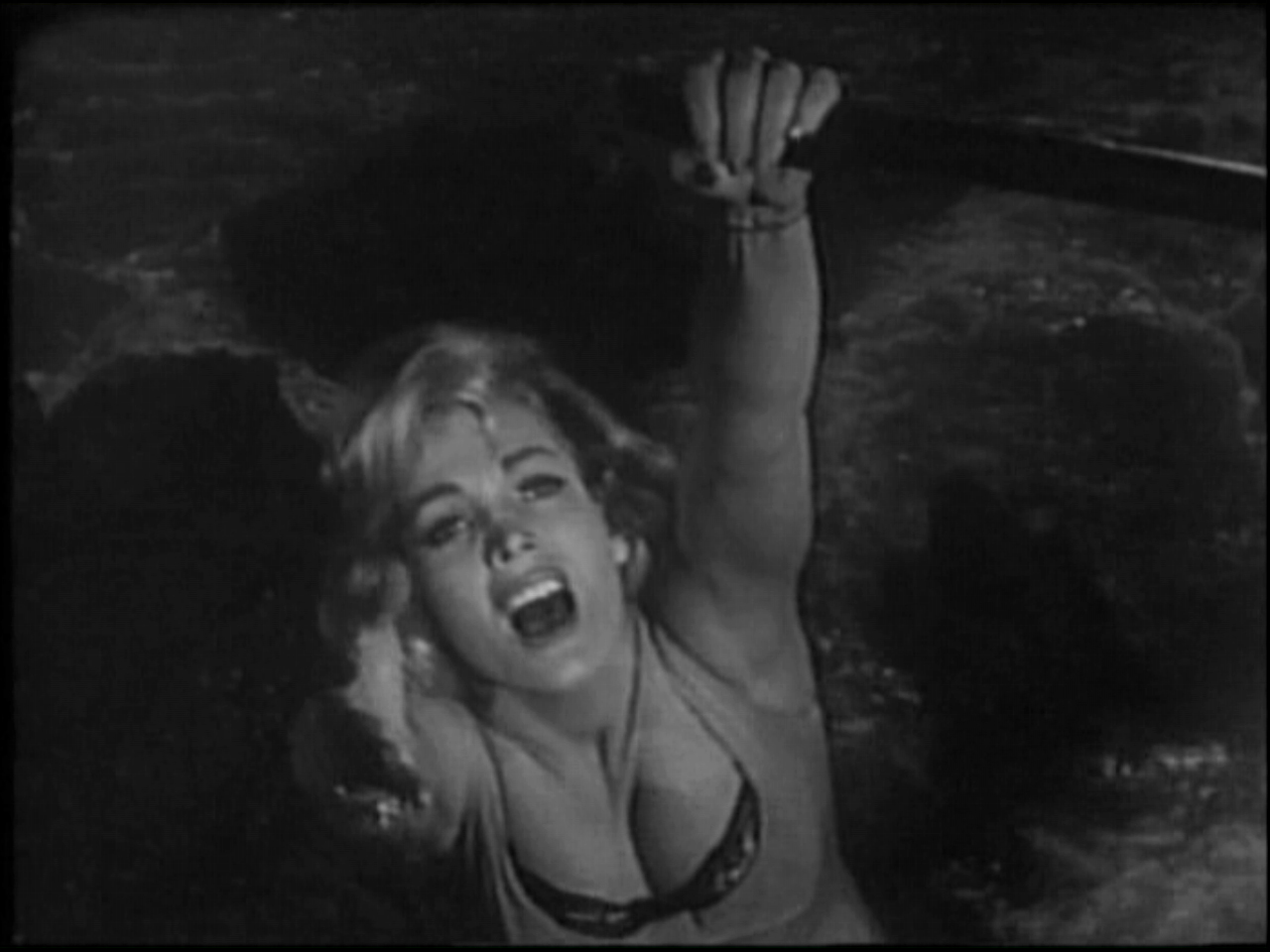
Juli Reding during a pivotal scene in Tormented

From the DVD case:

This psychological chiller tells the story of a man who pushes his mistress out of a lighthouse to her death, only to have her ethereal body parts return to haunt him.

With mostly laughable special effects this film proves that the best fissions are those created by the imagination. (1960, b&w)

Mark says:

Ok, so you’re not going to go to sleep with the lights on after viewing this film, but I think you’ll find it entertaining.

Tormented stars one of my favorite B-actors, Richard Carlson (It Came from Outer SpaceCreature from the Black Lagoon), playing the part of Tom Stewart, a jazz pianist, who is about to marry Meg Hubbard (Lugene Sanders). Unfortunately, Tom has a former mistress, a Marilyn Monroe knock-off named Vi (Juli Reding) who is not so willing to let him go.

Lucky for Tom, Vi leans against a lighthouse railing that gives way. Vi dangles from the top of the lighthouse, and though Tom could easily save her, he pauses long enough to let Vi fall to her death. As Vi’s body washes off to sea, Tom believes all his troubles are over.

But we know better.

Vi, of course, comes back to haunt Tom (one body part at a time, it seems) and to ensure his marriage to Meg never takes place.

The acting is what you’d expect from a B-picture horror film of the era, mostly schlock. Even Richard Carlson seems awkward in his role, especially as he feigns his jazz piano numbers. The other acting is barely noteworthy, though Joe Turkel (Village of the Giants) turns in an amusing performance as Nick, the blackmailer.

Tormented probably could have been a spooky little film, but the effects and acting are just too cheesy to make the viewer uneasy.

This movie was written and directed by low-budget king, Bert I. Gordon (Beginning of the EndEmpire of the Ants). You may not experience many genuine chills, but you will be treated to some entertaining B-movie camp goodness created by a master of the genre.

Scene to watch for: Tom gets in an argument with a disembodied head.

Line to listen for: “Tom Stewart killed me! Tom Stewart killed me!”

Notes of interest: Bert I. Gordon’s daughter, Susan Gordon, plays Meg’s little sister, Sandy. Also, Joe Turkel, who plays Nick, the blackmailer, later went on to play the ghostly bartender, Lloyd, in Kubrick’s The Shining.

Mark’s Rating! ! ½ out of 5.

This Island Earth (1955)

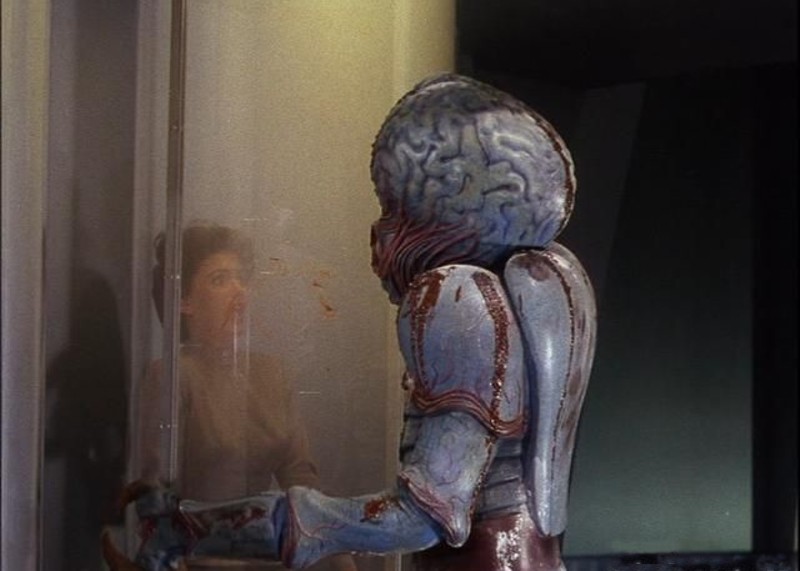
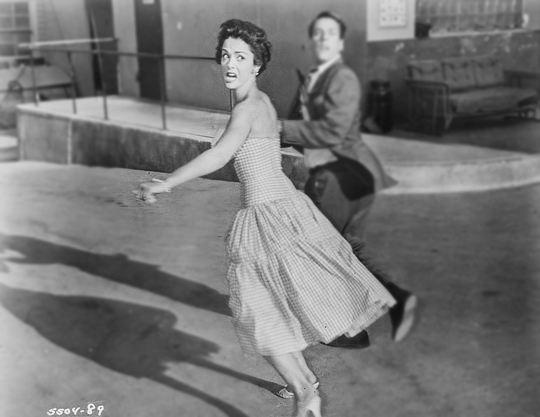
Faith Domergue in a harrowing scene from This Island Earth

From IMDb:

(Note: I usually take the film description from the DVD/VHS case. However, in this instance, the DVD case is so full of inaccuracies that I thought I’d avoid confusion and use a plot synopsis from IMDb. – MM) Weird events in the life of atomic scientist Cal Meacham (Rex Reason) culminate in an invitation from the strange-looking Exeter (Jeff Morrow) to work at a secret lab in Georgia, supposedly for the cause of world peace. Other scientists are already there, including the gorgeous Ruth Adams (Faith Domergue). They quickly discover there’s more to Exeter than meets the eye. Is he benevolent? It may take an interstellar journey to find out.

Mark says:

 This Island Earth is one of my favorite science fiction films of the 1950s. It has everything a B movie enthusiast could want, starting with a stellar cast.

Rex Reason (The Creature Walks Among Us) is Dr. Cal Meacham, a capable scientist with a sonorous voice that commands authority. This is my favorite role for Mr. Reason, and unquestionably the role for which he is most remembered. Faith Domergue (It Came from Beneath the SeaCult of the Cobra) plays fellow scientist and love interest, Ruth Adams. Ms. Domergue is ideal as the sensuous genius. Finally, Jeff Morrow (KronosThe Giant Claw) is Exeter, the alien agent on mission from the distant planet, Metaluna. Ironically, Exeter exhibits more human qualities and pathos than our hero, Dr. Meacham. Morrow is a veteran of 1950s B movies, and though I’m not always impressed with his performances, he really shines here as a human sympathizer from outer space.

In smaller roles, Robert Nichols (The Thing from Another World) is Meacham’s assistant, Joe Wilson. Joe’s attitude towards his boss can be characterized as “adoring.”  This aspect was picked up by Mystery Science Theater 3000: The Movie(1996), with some humorous results. Lance Fuller (The She-CreatureVoodoo Woman) is Brack, Exeter’s assistant, who is less than sympathetic to the human cause. The Monitor of Metaluna is played by Douglas Spencer, who I most fondly remember as Scotty in 1951’s The Thing from Another World. Rounding out the cast is Russell Johnson (Attack of the Crab MonstersIt Came from Outer Space) as Steve Carlson, one of the few people at the alien compound who has not been subjected to the Metalunan “Thought Transformer.”

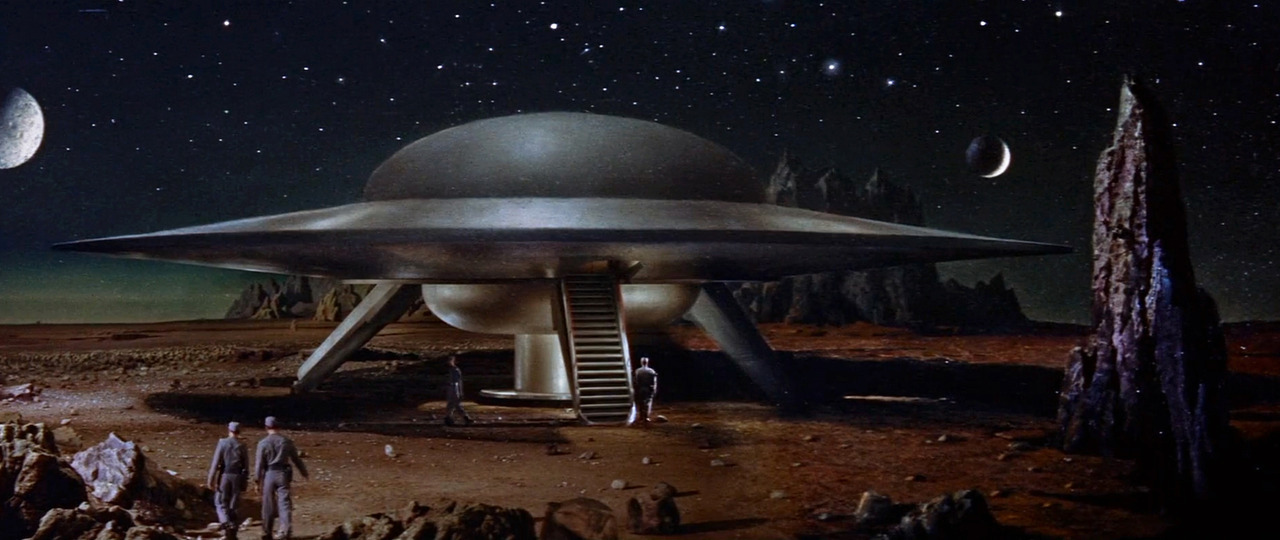
Besides a great cast, This Island Earth features some stunning visuals and special effects, enhanced with vivid color created by the three-strip Technicolor process. Though simple by today’s standards, the creative matte paintings, colorful sets, and miniatures are some of the best of the era. We are also treated to a cool flying saucer and lots of impressive explosions. For me, the limited technology lends to a heightened sense of fantasy, and I would argue that these effects stand up even today.

Of course, a great cast and special effects mean little if the story is not good, and This Island Earth (based on the novel of the same name by Raymond F. Jones) has one of the most intelligent plotlines of the era. The story is told in essentially two parts. The first portion is a build up and mystery. Dr. Cal Meacham receives a mysterious catalog filled with electronic gadgets far beyond the technology of modern man. He later obtains parts for an “Interocitor” and successfully assembles it. Upon completion, he discovers the Interocitor, which looks something like a triangular television, is a communication device. Exeter appears on the screen and offers Dr. Meacham an opportunity to join a select team of scientist for a purpose not revealed. Exeter is suspiciously alien, with a tall forehead, white hair, and a skin color similar to that of an Oompa-Loompa. Cal is suspicious, but takes a ride in a “trick airplane” to a remote location in Georgia.

Brack (Lance Fuller) and Exeter (Jeff Morrow)

The intrigue deepens when Cal arrives at the compound to find that his guide is an old colleague and lover, Dr. Ruth Adams. Strangely, Ruth claims to have no romantic memory of Cal. The camp is filled with world famous scientists, all specialists in the fields of nuclear energy. There is a pervasive atmosphere of mistrust and Cal’s meeting with Exeter does little to ease his mind. Exeter claims to have assembled the scientist to put an end to war, but Cal notes that all efforts are focused on the production of nuclear energy, with no experts assembled to assist with the practical application of the energy.

Eventually an alliance forms between Cal, Ruth (who finally admits she remembers Cal romantically) and another scientist, Steve Carlson (Russell Johnson).  As they come to trust one another, they share discoveries regarding Exeter and his project. One of the most disturbing discoveries is that the other scientists have been subjected to a Thought Transformer that deprives them of their freewill.  Cal and company decide to gather as much information as possible and escape the compound.

Of course, nothing is easy, and as the trio attempt to make their escape, Exeter is given orders to return to Metaluna and to bring Drs. Meacham and Adams with him. As Cal and Ruth attempt to escape in a small aircraft, they are pulled into a Metalunan saucer and the second portion of the film begins.

The second half of the film is a space adventure. The Earthlings are transported to Metaluna and learn of the planet’s plight. Barely escaping a jaunt through the Thought Transformer, they flee the dying planet, with the aid of the benevolent Exeter, and return to Earth. This portion of the film resolves questions posed in the first half. Namely, we learn why the Metalunans enlisted the aid of Earthling scientists and what they planned to do with all the nuclear energy they hoped to produce. I won’t give away these secrets here, but I will tell you it has nothing to do with peace on Earth.

Mutant

These final sequences not only feature the stunning visuals I mentioned earlier, but they also introduce us to the “monster” of the movie, a Metalunan Mutant bent on destroying our Earthling heroes. The Mutant’s head was actually a rejected design for the Xenomorph in It Came from Outer Space.  It’s exposed brain and bulbous eyes helped it become an iconic figure in 1950s science fiction cinema. For the most part, though, the creature is rather silly. The extended, insect-like arms flopping about certainly do not add to the menace.

Though the first segment of the movie is more engaging, the second half is by no means anticlimactic. The film as a whole is a fun and satisfying piece of science fiction, and withstands repeated viewings. Believe me, I know.

This Island Earth is directed by Joseph M. Newman. The Metaluna scenes, however, were re-shot by Jack Arnold after Universal expressed their dissatisfaction with Newman’s work.

Scene to watch for: Exeter takes an oddly optimistic view concerning the destruction of his home planet.

Line to listen for:  “In this place I wouldn’t believe my grandmother!”

Mark’s Rating! ! ! ! ½ out of 5.

Island of Terror (1966)

From the video case:

On a tiny island off the coast of Ireland, a new breed of terror is unleashed. In his quest to find a cure for cancer, a research scientist conducts an experiment involving mutated cells. But, this attempt to benefit humanity becomes a nightmare that threatens the entire human race.

The tranquil island is suddenly rocked by the mysterious death of a local farmer. When he is found in a cave, not a trace of bone is left in his body; he has been reduced to a horrible, shapeless mass. Enter eminent pathologist Dr. Brian Stanley (Peter Cushing) and Dr. David West (Edward Judd), a brilliant bone specialist.

Working together in a desperate race against time, they must find a way to destroy the seemingly indestructible, ever-multiplying horde of bone-eating creatures before the mutant monsters kill everyone on the island and spread like a deadly plague across the entire planet. (1966, color)

Mark says:

I credit Island of Terror for reigniting my interest in old sci-fi/horror movies. Several years ago I caught this movie on television. I remembered it from my youth and was enthralled to see it again through the eyes of an adult. As I was watching the movie, a friend dropped by and we finished watching it together. Afterwards, he suggested we rent a slew of old sci-fi/horror films and view them over the course of a few days. That’s exactly what we did, and I have been re-hooked ever since.

What really makes this film work is the dynamic between the two lead characters, Peter Cushing (The Curse of FrankensteinThe Abominable Snowman) and Edward Judd (The Day the Earth Caught Fire). Both men play their roles (Dr. Stanley and Dr. West, respectively) without a trace of campiness. Edward Judd actually has more of the lead role, and gets the girl (Carole Gray), but it’s Peter Cushing who gets the better lines.

Another interesting aspect of this film are the unusual monsters. They’re sort of a large turtle-shelled creature with a single tentacle that extends from the front. They reproduce by dividing in half and producing a gunk that looks like some sort of Chinese noodle soup. They’re not monsters you will easily forget.

If I were to find fault with this movie, it would be that it sometimes loses momentum. There’s a particularly slow scene where we watch the doctors put on radiation suits. First the pants, then the shoes, then the top, and then the hood, and then they finally buckle themselves in. I’m not exactly sure why we had to see all that. Plus, the radiation suits are decidedly unimpressive. They don’t look very sturdy and rather resemble cheap condoms.

Other than a lack of good editing, this film is highly entertaining. Keep in mind the significance this film plays in my personal history when you see my rating.

Island of Terror is directed by Terence Fisher (Horror of DraculaThe Curse of the Werewolf).

Scene to watch for: Dr. Stanley gives Dr. West a hand. Literally.

Line to listen for: “If I hear another sound out of you I’m gonna smash your face in and throw you out for those things to get.”

FYI: This movie is also known as Night of the SilicatesThe CreepersThe Night the Creatures CameThe Night the Silicates Came.

Mark’s Rating! ! ! ! out of 5.

Duel (1971)

From the video case:

A traveling businessman (Dennis Weaver) is suddenly menaced on the highway by a huge diesel truck. Although he can never see the psychopathic driver of the truck, he soon realizes that this guy is out to kill him! Duel is a classic of the action-suspense genre which helped launch the career of director Steven Spielberg. (1971, color)

Mark says:

After seeing Duel for the first time as a child, I had sore muscles from tensing up so often. Thank God for commercials, or I may have petrified permanently. Viewing the film as an adult, I am still struck by how much suspense Mr. Spielberg conjures with a simple story and sparse dialog.

Duel was originally a 74 minute made-for-TV movie that later, with added footage, became a cinematic film distributed throughout Europe. Spielberg cast Dennis Weaver in the lead role of David Mann after seeing him in the movie, Touch of Evil. Of course, most of us fondly remember Mr. Weaver as Chester from the old Gunsmoke TV series, or as the title character in TV’s McCloud.

David Mann is a modern day Everyman. He’s bound to his job, trudging through life in a mood of quiet desperation. David is an emasculated figure who, throughout the course of the movie, is taunted by children, berated by his wife, and laughed at by yokels at a truck stop. We get the feeling that he has not had a good day in a long time. The 1970 red Plymouth Valiant that he drives seems to be an extension of his inadequacy. Weaver plays the part superbly, and though we find him more than a little pathetic, we can’t help but root for him. After all, he’s more like us than we’d care to admit.

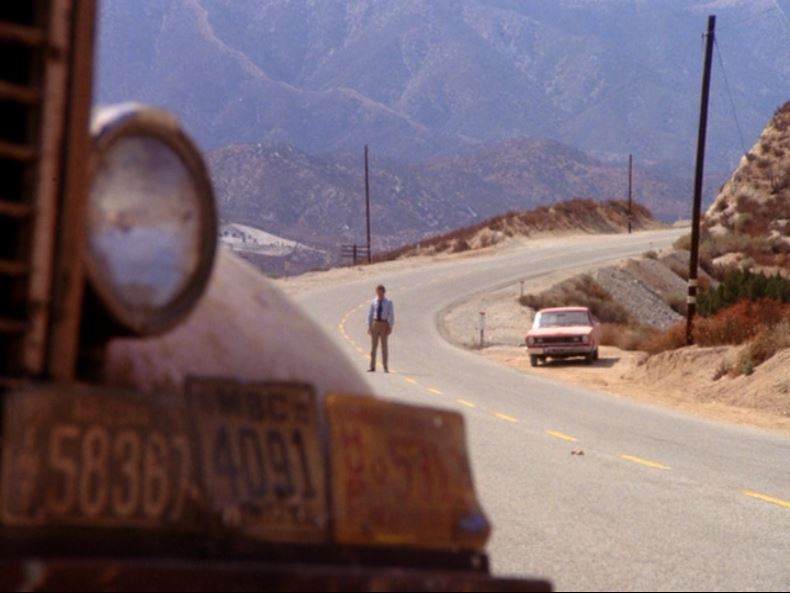
The antagonist of the story is a Peterbilt 351 tanker truck. Sure, the truck has a driver (stuntman and character actor, Carey Loftin), but we never get a clear look at him. We see one of his arms, and a glimpse of his boots, but it’s the truck itself that seems to be the real entity. It roars and groans and attacks with the fury of a true monster. It also moves with seemingly supernatural speed. Thanks to this movie, I’m still uncomfortable when a truck pulls up behind me while I’m stopped at a railroad crossing.

We never learn the reason for the truck driver’s attack on Mr. Mann, nor do we learn of his identity, but ultimately, these things are not important. What is important is that David Mann has come up against a problem he can’t ignore, and if he doesn’t face it, he will pay with his life. Mann encapsulates a primary theme of the film when he says:

Well, you never know…you just never know. You just go along figuring some things don’t change ever, like being able to drive on a public highway without someone trying to murder you. And then one stupid thing happens. Twenty, twenty-five minutes out of your whole life, and all the ropes that kept you hanging in there get cut loose, and it’s like, there you are, right back in the jungle again.

This is a theme Spielberg would come back to often: an ordinary man trapped in an extraordinary situation.

You would think a movie about a truck chasing a man down would get dull after awhile, but it never does. Spielberg builds suspense so masterfully, we seldom get a chance to feel bored, or even relaxed. The off the road scenes are just as suspenseful. I especially enjoy the segment at Chuck’s Cafe where Mann tries to determine which truck driver is the psychopath trying to kill him. It’s filled with such tension that we get the feeling Mr. Mann has gone a tad insane. There’s also some wonderful campesque dialog that will surely elicit a smile or two.

The final chase scene is unbelievably tense. I remember yelling at the TV when I was a kid, “Go, go, GO!” Weaver is completely convincing in his panic, and for a few moments we feel he is not going to make it. When he does triumph, we experience his elation and relief with him. We are left with a sense that by conquering this problem, he’ll have more control over his everyday life, too. Which, in a strange way, is kind of inspiring.

The “death” of the truck is an unforgettable moment. It’s filmed in slow-motion, so every ounce of satisfaction is drawn out of it. This has to be one of my all-time favorite monster death scenes.

While doing internet research on Duel, I was pleased to find that it is held in high regard by both fans and critics alike. As a side note, I wonder what Spielberg could produce today if he was forced to work with the same budget ($375,000) and time constraints (2 weeks).

The screenplay was written by Richard Matheson (The Night StalkerThe Incredible Shrinking Man), and based on his short story of the same name. Matheson states that the story was inspired by a road rage incident that occurred shortly after the JFK assassination.

Duel was Steven Spielberg’s feature-length directing debut.

Scene to watch for: Dennis Weaver knocks a sandwich out of the hand of the wrong man.

Line to listen for: “He’s got some, some, some souped-up diesel.”

Trivia: Spielberg said that the multiple license plates on the front bumper of the truck suggested that the truck driver is a serial killer which “ran down other drivers in other states.”

Mark’s Rating! ! ! ! ! out of 5.
Forbidden Planet (1956)

From the video box:

A dutiful robot named Robby speaks 188 languages. An underground lair provides astonishing evidence of a populace a million years more advanced than Earthlings. There are many wonders on Altair-4, but none is greater or more deadly than the human mind.

Forbidden Planet is the granddaddy of tomorrow, a pioneering work whose ideas and style would be reverse-engineered into many cinematic space voyages to come. Leslie Nielsen portrays the commander who brings his space cruiser crew to the green-skied Altair-4 world that’s home to Dr. Morbius (Walter Pidgeon), his daughter (Anne Francis), the remarkable Robby, and to a mysterious terror. (1956, color)

Mark says:

Not many people would disagree that Forbidden Planet is one of the best sci-fi films that came from the 1950s. Produced by a major studio (MGM) and laden with stunning visuals and effects, Forbidden Planet is a true sci-fi classic.

But it’s not just the production values and special effects that give Forbidden Planetits classic status. The storyline and concepts are equally intriguing, giving this movie much more dimension than similar sci-fi pictures of the time. Here’s a terribly over-simplified synopsis:

Spacecruiser C-57-D, under the command of Commander John J. Adams (Leslie Nielsen), is sent on a mission to the planet Altair-4 to investigate the destiny of the Bellerphon, a fully manned craft that landed on Altair-4 twenty years previous but has not been heard from since. They discover the only survivor of the Bellerphon is Dr. Edward Morbius (Walter Pidgeon), who is suspiciously anxious for the rescue party to return to Earth without him.

Morbius explains that the crew of the Bellerphon, after making the decision to return to Earth, were “literally torn limb from limb” by an invisible force. Only Morbius and his wife seemed to be immune to the force. The Bellerphon itself was vaporized while trying to leave the planet (Morbius and his wife, fascinated with the new world, were not aboard the ship.)

Within the year, Morbius’s wife died of natural causes, but not before giving birth to a beautiful daughter, Altaira (Anne Francis). Morbius, Altaira, and a fantastic robot called Robby have been the only inhabitants of the planet since. They have never again been bothered by the destructive force.

Commander Adams needs further instructions from home base regarding Dr. Morbius. Unfortunately, building a communication device powerful enough to reach Earth takes several days, even with the help of the super-strong Robby. Meanwhile, an invisible beast enters the ship and kills Chief Engineer Quinn (Richard Anderson, who you might recognize as Oscar Goldman from the Six Million Dollar Man tv series).

The death of Quinn is strikingly similar to deaths described by Dr. Morbius concerning the crew of the Bellerphon. Commander Adams decides that it is time to confront Morbius and find out exactly what he knows about the planet Altair-4.

Dr. Morbius relates the history of the Krell, an ancient race “a million years more advanced” than Earthlings that once inhabited the planet. The Krell were a benevolent people evolved to a point of unsurpassed intellectual ability. Morbius was able to ascertain this through surviving Krell documents and machinery. Inexplicably, the Krell vanished overnight while on the verge of their greatest intellectual achievement, a society completely devoid of “instrumentation.”

Morbius also relates how his intellectual capacity has been doubled by using one of the Krell machines. The machine proved fatal to one of Morbius’s crew mates, and he forbids the commander or any of his crew to use it.

Of course, the extinction of the Krell is directly linked to the events now afflicting the men of Spacecruiser C-57-D. I will not reveal the answer to the mystery here out of respect for the uninitiated.

Anne Francis (who also starred in the title role of the tv series, Honey West) is superb in her portrayal of the alluring, intelligent, yet naive Altaira. She conveys a sense of innocence as well as an aura of sex appeal, and easily competes with the astounding sets and visuals of the film.

Leslie Nielsen (Day of the AnimalsDracula: Dead and Loving It) is competent in the role of Commander John J. Adams. Commander Adams is personable, but can also be authoritative when need be. Warren Stevens, portraying Lt. ‘Doc’ Ostrow, is the commander’s right-hand man and seems to be intellectually superior to him. As Dr. Morbius sarcastically points out, you don’t need brains to lead, “just a loud voice.”

Walter Pidgeon (Voyage to the Bottom of the Sea) is convincing as the stubborn Dr. Edward Morbius, but at times he seems bored with the part. Dr. Morbius is obviously an important character, but when the movie drags (as it sometimes does) it is primarily during his scenes. I think more editing could have helped the situation.

There is plenty of humor in Forbidden Planet. The crew is playful and even Commander Adams pulls an occasional prank. The casual humor is not distracting, however, certain scenes with the cook (played by Earl Holliman) are almost obnoxious in their attempts to be funny. The sequences involving Holliman and Robby are particularly embarrassing. Robby belching after analyzing the cook’s bourbon seems incredibly out of place for such a serious sci-fi effort.

Bebe and Louis Barron composed the “electronic tonalities” (original music) for Forbidden Planet. The tonalities not only add to a futuristic atmosphere but also serve as some of the sound effects. As the video box description states, this was “the first all-electronic musical soundscape in film history.”

Story by Irving Block (War of the SatellitesKronos) and Allen Adler. Screenplay by Cyril Hume.

Directed by Fred M. Wilcox.

Scene to watch for: The “Monster from the Id” shows its shape and size while crashing through the disintegrator beam in an attempt to attack the ship. (Side note: Every time I watch this segment I’m put in mind of the animated “Judge” from Pink Floyd’s The Wall.)

Line to listen for: “Sorry miss, I was giving myself an oil-job.”

TriviaForbidden Planet is loosely based on William Shakespeare’s The Tempest.

Mark’s Rating! ! ! ! ½ out of 5.

The Monolith Monsters (1957)

From the video case:

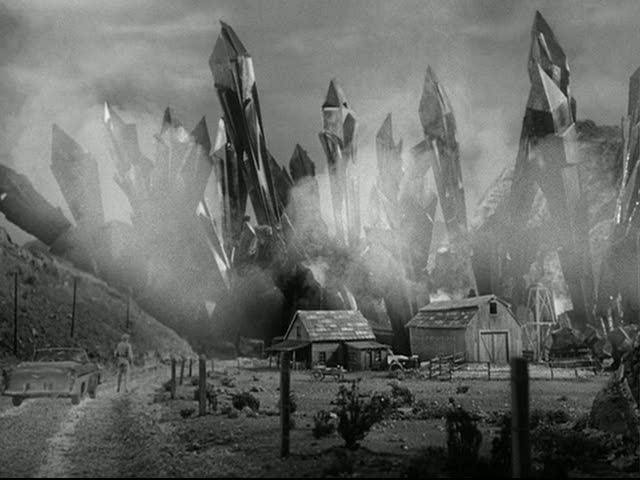
A giant meteor crashes to Earth near the small town of San Angelo, and local geologist Ben Gilbert (Phil Harvey) brings a fragment back for testing. Shortly afterwards, fellow geologist Dave Miller (Grant Williams) shows up and finds the lab filled with rocks and Ben cold and dead, his body turned completely to stone.

Meanwhile, Dave’s girlfriend, Cathy Barrett (Lola Albright), takes her students on a desert field trip and young Ginny Simpson (Linda Scheley) takes one of the strange rocks home. Soon, like the lab, the Simpson farm is in ruins, Ginny’s parents are dead, and she herself is half petrified, but still alive.

Now, in a desperate race against time and nature, Dave and Professor Arthur Flanders (Trevor Bardette) must unlock the secret of the deadly rocks from outer space before they blanket the world and destroy mankind in an unstoppable wave of stone cold terror. (1957, b&w)

Mark says

The Monolith Monsters is one of my favorite lesser-known Universal films. It’s an intriguing, and somewhat unusual story, with an array of colorful characters. The acting isn’t great, mind you, but there is something about these folks that make you like them.

San Angelo is sort of Mayberry with a Twilight Zone twist. Somehow, this movie gets you caught up in its little adventure.

The hero of Monolith Monsters is Dave Miller, played by Grant Williams (The Incredible Shrinking Man). He’s one of two local geologists. His partner is Ben Gilbert, portrayed by Phil Harvey (The Deadly MantisMonster On The Campus). Both fellows are very likable, and I wouldn’t mind chatting with either of them.

Dave’s girlfriend is school teacher, Cathy Barrett (Lola Albright). She’s not the most interesting person, but a nice lady with an even temperament. She also seems to be the only datable woman in the town of San Angelo.

My favorite character is Les Tremayne (The Angry Red PlanetThe War of the Worlds) as newspaper man, Martin Cochrane. He mopes around and complains about his lot in life, and sometimes waxes philosophical. It’s hard to pinpoint his purpose in the film, but I’m glad he’s around, just for color.

There are other fine characters in this movie, too. For example, Steve Darrell (Tarantula) as desert farmer, Joe Higgins. He doesn’t get much screen time, but what he does get he makes the most of. I even like the opening narration by Paul Frees (The Thing from Another World).

You get the gist of the story by reading the video description above. I will only add that I think that the special effects, while by no means spectacular, are at least interesting. The plot has some obvious holes in it, but all in all, forgivable.

Each aspect of this movie, when taken individually, seems barely adequate, but somehow, when put all together, this conglomeration of adequacy becomes something more. It’s hard to place my finger on exactly why, but I really like this movie.

Directed by John Sherwood (The Creature Walks Among Us).

Scene to watch for: Little Ginny learns a lesson in lizard love.

Line to listen for: “Negative cleavage?”

Trivia: You may recognize lead actress, Lola Albright, as nightclub singer Edie Hart from the TV series, Peter Gunn.

Note of interest: The set for San Angelo, the fictional town in this film, was also used in two other Universal sci-fi films of the 1950s: Tarantula and It Came from Outer Space.

Mark’s Rating! ! ! ! out of 5.
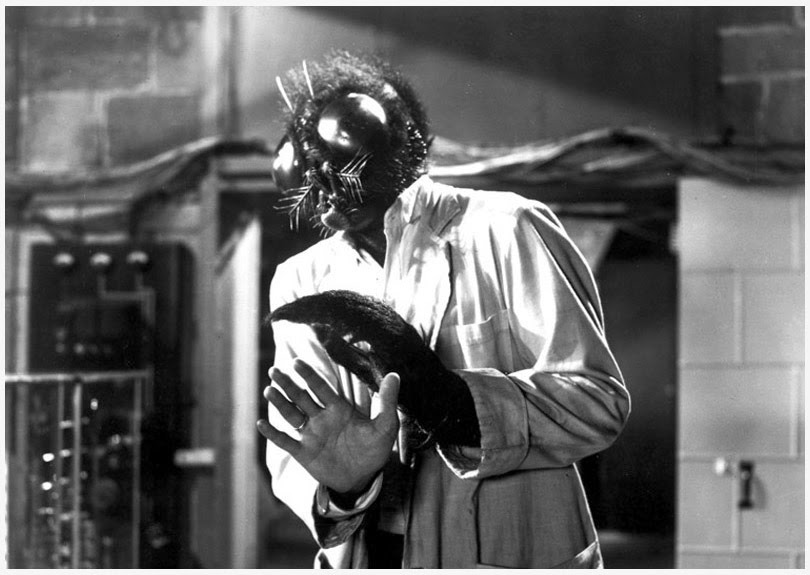
The Fly (1958)

From the video box:

Vincent Price portrays the brother of a brilliant research scientist (Al Hedison) who discovers how to transport matter through space. But things take an astoundingly bizarre turn when Hedison’s atoms intermingle with those of a common housefly, leaving him with the head of an insect while his own head is attached to the fly’s body. A gruesome freak of nature, his desperate battle to return to normal becomes all the more difficult when he begins to lose his human will. (1958, color)

Mark says:

I don’t think anyone who ever saw this movie as a kid ever forgot it. I know that I never have.

Al Hedison (who later changed his name to David Hedison) and Patricia Owens do a capable job portraying Andre and Helene Delambre, a very happily married couple with a young son, Philippe. You may recognize Philippe (Charles Herbert) as Buck Zorba from 13 Ghosts (1960), or from his minor role in The Monster that Challenged the World (he played one of the kids fighting for the sailor’s cap). Personally, I think he is less than convincing in any role, but his brief appearances in The Fly does not hamper the film, much.

The Fly is filled with some of the most memorable scenes from sci-fi/horror film history, beginning with the opening sequence. As the story opens (most of the tale is told in flashback) we find Helene Delambre crushing her husband’s head and arm in a hydraulic press. The scene is shockingly gruesome, and sets an uneasy tone for the rest of the movie. This segment is much more graphic (and in color!) than similar films of the time.

Another image that leaves an indelible impression is when Helene tears off Andre’s ominous black hood to see his hideous fly head for the first time. We are suddenly given the fly’s point of view and watch multi-images of Helene as she screams. It’s hard to express how startling this scene was upon first viewing. The fly’s head may not be much by today’s standards, but it was certainly more than adequate for the time.

And who can forget the concluding segment as the spider advances on the hapless human-headed fly? It’s hard to imagine a scene that inspires more pity and horror. Well, I suppose there’s a touch of humor here, too, but mostly pity and horror.

But The Fly is much more than just a sci-fi shockfest; it’s also a love story. Helene’s devotion to her husband, even after his transformation, is not only admirable, but touching. Because we get a genuine feeling for the affection Helene and Andre share for each other (and to a lesser extent, Philippe) the tragedy that befalls them seems even more calamitous.

Vincent Price is quite convincing as Andre’s brother, François. Of course, my good opinion of Mr. Price borders on the brink of bias, and I wouldn’t completely blame you if you regarded my praise as a bit suspect. Still, it is hard to imagine this film being as successful (or as fun) without him.

Unfortunately, The Fly has its share of unintentional humor. For example, when Andre attempts to teleport the family cat, the kitty never reappears. Instead, we hear his pained meows calling from “somewhere in space.” Even Andre says, “It’d be funny if life wasn’t so sacred.”

Also, when Andre starts losing his human will, his fly hand begins to battle his human hand. At first, it simply appears that Andre is having a tough time controlling his fly instincts. However, by the end of the film, it’s a full out war between the hands, and it can seem a little comical.

In addition, it’s hard not to grin when you hear the human-headed fly crying for help. Even as a kid I couldn’t take that voice completely seriously.

I would also suggest that the pacing is just a little slow. It’s good that we get to know the Delambre family, and I like the anticipation building up to the unveiling of the fly’s head, but it seems we are held in suspense just a wee-bit too long. But I’ve never been known for my attention span.

None of the drawbacks I mention above are enough to keep me from listing The Fly as one of my all-time favorite science fiction films. If you haven’t seen it for awhile, I heartily recommend you watch The Fly again.

Directed by Kurt Neumann (KronosRocketship X-M).

Based on a story by George Langelaan, scripted by James Clavell.

Scene to watch for: The disgusted look on Helene’s face as Andre (under his hood) slurps up the milk and rum mixture she has prepared for him.

Line to listen for: “Hellllp meeee!”

Mark’s Rating! ! ! ! ½ out of 5.

Fiend Without a Face (1958)

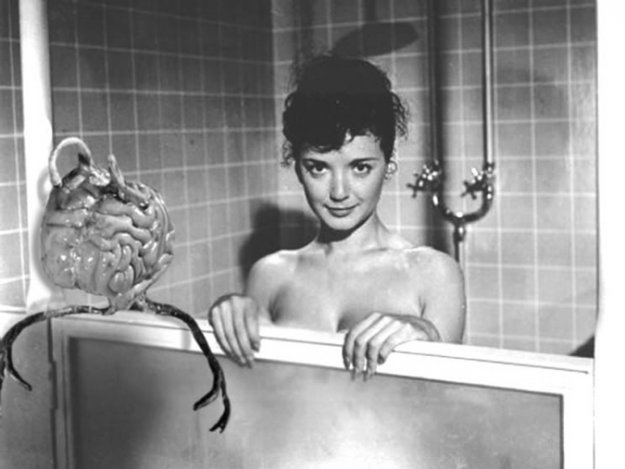
Kim Parker in a publicity still for Fiend Without a Face

From the DVD case:

A scientist’s thoughts materialize as an army of invisible brain-shaped monsters (complete with spinal-cord tails!) who terrorize an American military base in this nightmarish chiller, directed by Arthur Crabtree (Horrors of the Black Museum). This outstanding sci-fi/horror hybrid is a special effects bonanza, and a high-water mark in British genre filmmaking. (1958, b&w)

Mark says

Fiend Without A Face is an Amalgamated Production, geared to an American audience, but filmed almost entirely in England. A Canadian setting is used to serve two purposes: First, the action is near enough the US border to keep the attention of American film-goers, and second, it helps explain the odd accents. Marshall Thompson (First Man Into SpaceIt! The Terror from Beyond Space) was given the lead role to further enhance the American ambiance.

Thompson plays Maj. Jeff Cummings, second in command at an American airbase located in Canada. The neighboring community, consisting primarily of dairy farmers, is suspicious of the military’s radiation experiments and blame them for the sudden decrease in milk production.

Kim Parker (Fire Maidens from Outer Space) plays Barbara Griselle, sister to the first victim. Maj. Cummings is immediately attracted to Barbara, though it takes her awhile to warm to him. Barbara is featured in a shower sequence (see promotional still, above), obviously added to embellish the sexiness of the picture, but the scene comes off as rather tame and a bit awkward. For 1958 it was very hubba-hubba, though.

Barbara works for Professor Walgate (Kynaston Reeves), an eccentric but kindly old man who writes books on such topics as “The Principles of Thought Control,” and “The Energy of Thought.” It doesn’t take much to figure out that Professor Walgate is somehow responsible for the creation of the fiends.

Other characters include Capt. Al Chester (Terence Kilburn), a good friend of Maj. Cummings; Constable Gibbons (Robert MacKenzie, Womaneater), a local rabble-rouser; Mayor Hawkins played by James Dyrenforth (Horror Hotel), and Dr. Bradley, portrayed by Peter Madden (The Kiss of the VampireDr. Terror’s House of Horrors). You may also recognize Michael Balfour (Quatermass 2) in the role of Sgt. Kasper, and Launce Maraschal plays Deputy Mayor Melville.

The story becomes more far-fetched as the movie progresses, and finally dissolves into nonsense, but it’s not the acting nor the story that you’ll remember about Fiend Without A Face. It’s the monsters.

The monsters were created by German team of stop-motion animators, K.L. Ruppel and Florenz Von Nordhoff. The creatures are so bizarre that they won’t soon escape your memory. Basically, they are brains that crawl along (inch-worm fashion) on spinal cords, but leap with amazing agility. They have antennae, but no faces, and survive by slurping out the brains and spinal columns of their victims.

At the outset of the film the fiends are invisible. We only hear what sounds like a heartbeat, and a bone-crunching noise. When the monsters attack, the victims grab for their necks and we hear the most repulsive slurpy-sucky sounds ever created for film. Much credit is due to sound technicians Peter Davies and Terence Poulton for making us cringe even before we see the beasts.

The story of the fiends’ creation is too complex and absurd to delve into here; suffice it to say that Professor Walgate, with the help of siphoned radiation, accidentally created the monsters through “thought materialization.” We don’t actually see the creatures until the final sequences of the film, when, through a boost of radiation, they become visible.

The stop-motion animation gives the creatures a weird and fascinating screen presence. The visuals, combined with the repulsive sound effects, make the monsters some of the most unique of the era. There is a particular scene, when a legion of the creatures come flying through a window, where their movements remind me of mutated sperm swimming under a microscope. But that might be just me.

More revolting than the creatures themselves is the manner in which they die. After being shot, the faceless fiends sputter blood in disgusting globs, making Fiend Without A Face one of the most graphic sci-fi films of the 1950s. The effect is quite shocking, considering the mediocrity of the rest of the film. When the radiation supply is cut off the creatures meet their demise by dissolving into a putrid slime. Quite nauseating, really, but it’s great fun.

If not for the unconventional creatures, Fiend Without A Face may have been just another 1950’s sci-fi throw-away. However, considering the originality of the critters, plus the excellent stop-motion work and gruesome sound effects, this movie scores a few notches higher.

Scene to watch for: Constable Gibbons (Robert MacKenzie) shows up at a town meeting freshly lobotomized.

Line to listen for: “What the heck? I’m human. We’re all human here! We’re not monsters from outer space!”

TriviaFiend Without A Face is based on a short story, “The Thought-Monster” by Amelia Reynolds Long, which was originally published in Weird Tales (1930).

Recommendation: If you have some extra dough, I recommend the Criterion Collection DVD production of this film. It’s a great transfer, and the commentary with executive producer Richard Gordon (interviewed by film historian, Tom Weaver) is both informative and amusing.

Mark’s Rating! ! ! ½ out of 5.

Invasion of the Body Snatchers (1956)

From the DVD case:

Something evil has taken possession of the small town of Santa Mira, California. Hysterical people accuse their loved ones of being emotionless impostors; of not being themselves. At first, Dr. Miles Bennell (Kevin McCarthy) tries to convince them they’re wrong, but they’re not. Plant-like extraterrestrials have invaded Earth, replicating the villagers in giant seed “pods” and taking possession of their souls while they sleep. Soon the entire town is overwhelmed by the inhuman horror, but it won’t stop there. In a terrifying race for his life, Dr. Bennell escapes to warn the world of the deadly invasion of the pod people! Remade in both 1978 and 1997, this chilling combination of extraterrestrial terror and anti-conformity paranoia is considered one of the great cult classics of the genre. (1956, b&w)

Mark says:

I’d never commit myself to this, but Invasion of the Body Snatchers may be my all-time favorite sci-fi/horror film of the 1950s. I love the idea of society slowly being invaded by unfeeling creatures that look just like you and me. The story is based on a Collier’s Magazine serial by Jack Finney.

A lot has been said about the cold war symbolism in this movie, with the “pod people” representing either communists or McCarthyists. Because I don’t want to spend a lot of time on this aspect, let me quote Director Don Siegel’s take on this interpretation:

I think that the world is populated by pods and I wanted to show them. I think so many people have no feeling about cultural things, no feeling of pain, of sorrow. I wanted to get it over and I didn’t know of a better way to get it over than in this particular film. I thought I shot it very imaginatively. And I was encouraged all the time by [producer] Wanger. The film was nearly ruined by those in charge at Allied Artists who added a preface and ending that I don’t like.

The political reference to Senator McCarthy and totalitarianism was inescapable but I tried not to emphasize it because I feel that motion pictures are primarily to entertain and I did not want to preach.

Alan Lovell: Don Siegel. American Cinema. London 1975, S. 54

So there you go.

The preface and ending that Siegel mentions are the opening scene where Dr. Bennell (Kevin McCarthy) is being held as a mental patient, and the final scene where Bennell’s story is corroborated. Allied Artists did not want a negative ending and so the preface and conclusion were tacked on later. Bennell’s narration of the story was also added to help the viewer follow the plot (we are such idiots). Though I am accustomed to the Allied Artists version of the film, I certainly would be interested in a DVD that presents both renditions of this movie.

I’m not going to retell the story, as most of you have seen some version of this film already (if not the original, the 1978 or 1997 remakes). If you haven’t seen Invasion of the Body Snatchers in any of its incarnations, use the DVD description above as a synopsis.

However, I will discuss the talented actors that bring this story to life. Kevin McCarthy (The Howling) is perfect in the role of Dr. Miles Bennell. When playing the part of a human surrounded by pod impostors, it’s important that the human comes off as feeling and vulnerable. Dr. Bennell, as evident in his choice of profession, is a person who genuinely cares for other people. I love how he interacts with his nurse Sally, played by Jean Willes (Abbott and Costello Go to Mars). Their conversation is playful, almost flirty, and they obviously feel a great respect for one another. Dr. Bennell isn’t perfect, though. We learn that he is recently divorced, and perhaps devoted too much time to his work and not enough time at home.

Dr. Bennell’s love interest, Becky Driscoll, is played superbly by the ravishing Dana Wynter. Becky is also recently divorced, and finds herself in a rekindled romance with her high school sweetheart, Miles Bennell. The two actors work wonderfully together, and their fondness for one another is completely convincing. I always chuckle at this line Dr. Bennell uses on Becky as he opens a door for her:

Becky: Is this an example of your bedside manner, doctor?
Dr. Bennell: No, ma’am. That comes later.

The supporting cast is also impressive. King Donovan (The Beast from 20,000 FathomsThe Magnetic Monster) plays writer Jack Belicec, a man who finds himself duplicated on his own pool table. Carolyn Jones (1953’s House of Wax) is Jack’s wife, Theodora, who first notices the similarity between Jack and the body developing in their home. Also, featured in the preface and conclusion of the film, Whit Bissell (Monster on the CampusI Was a Teenage Werewolf) plays Dr. Hill, a man reluctant to believe the ravings of an obviously disturbed Dr. Bennell.

Of course, Siegel’s direction is what gives Invasion of the Body Snatchers its classy feel. This could have been another 1950’s sci-fi/horror camp schlockfest, but Siegel was wise enough to concentrate on the story and acting rather than throwing money away on special effects. The money that was used for special effects (less than $15,000) was put to good use by production designer, Ted Haworth. Haworth produced some amazing work for such a small budget. The greenhouse scene impresses me to this day.

I would be remiss not to mention how much the music of Carmen Dragon adds to the movie. Right from the outset we are steeped in a sense of foreboding. As seemingly innocent clouds roll by, Dragon’s startling theme alerts us to something sinister afoot. Before the action even begins, the suspenseful tone is set.

The scene everyone remembers is the final sequence (well, it should have been the final sequence) where Dr. Bennell runs out into traffic shouting insanely, “They’re here already! You’re next! You’re next! You’re next!” This would have been a fitting ending, and a warning to all of us to beware of becoming “pod people.” After all, there is a certain temptation to submit to the pod way of life. As one of the duplicates explains: “Love, desire, ambition, faith – without them life is so much simpler.”

But don’t be swayed, friends. Those pod folks are dull.

Scene to watch for: Dr. Bennell takes a pitchfork to the body replicas developing in the greenhouse.

Line to listen for: “I never knew fear until I kissed Becky.”

Trivia: Sam Peckinpah (who would later go on to direct the violent classic, The Wild Bunch) has a bit part as a meter reader in this film. He often claimed he was responsible for major script revisions, but when the screenwriter, Daniel Mainwaring, threatened to file an official complaint with the WGA, Peckinpah ceased his claims.

Mark’s Rating! ! ! ! ! out of 5.
Design a site like this with WordPress.com
Get started