Night of the Lepus (1972)

From the DVD case:

A hormone intended to alter the breeding cycle of rabbits overrunning ranchlands instead turn them into flesh-eating, 150-pound monsters. Stuart Whitman, Janet Leigh, Rory Calhoun and DeForest Kelly are among the intrepid humans facing the behemoth bunnies. They use guns, flames, and dynamite to subtract them, but the rampaging rabbits know how to multiply. Can anything stop these hare-y, scary monsters? (1972, color)

Mark says:

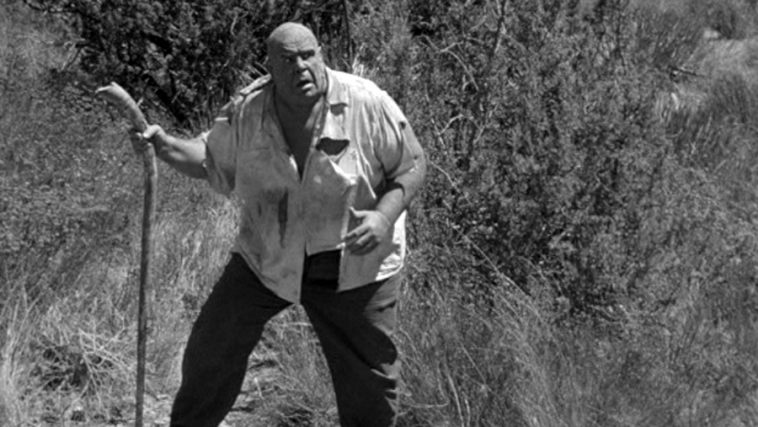
The most amazing thing about Night of the Lepus is that it is not played for laughs. Instead, the film is approached as a cautionary ecological tale regarding the fragile balance of nature. Director William F. Claxton (who directed a lot of television, including several episodes of The Twilight Zone), and a cast of veteran actors, among them, the great Janet Leigh (PsychoThe Fog), treat the script earnestly, as if the premise is not utterly ridiculous. I mean, the movie is about giant, bloodthirsty bunnies. That’s funny, right? Even the book it is based on, The Year of the Angry Rabbit by Russell Braddon, is described as, “a savagely humorous indictment of War, Nationalism and Capitalism.” Savagely humorous!  This movie may have had some success if it were created as a spoof of the giant, radiated, mutant bug/animal horror flicks that gained popularity in previous decades, but it is played absolutely straight.

So, how did MGM decide to make a picture like Night of the Lepus? Tom Weaver, in his book, Return of the B Science Fiction and Horror Heroes, put this very question to lead actress, Janet Leigh. Her response:

I read the script, and I have to tell you that it read very well. Night of the Lepus was made at the time of science fiction pictures like Willard and Ben and Frogs, and I must repeat the script read very well. No one twisted my arm and said I had to do it. What no one realized was that, no matter what you do, a bunny rabbit is a bunny rabbit! A rat, that can be menacing – so can a frog, spiders or scorpions or alligators – they could all work in that situation, and they have. But – a bunny rabbit? How can you make a bunny rabbit menacing, what can you do? It just didn’t work.

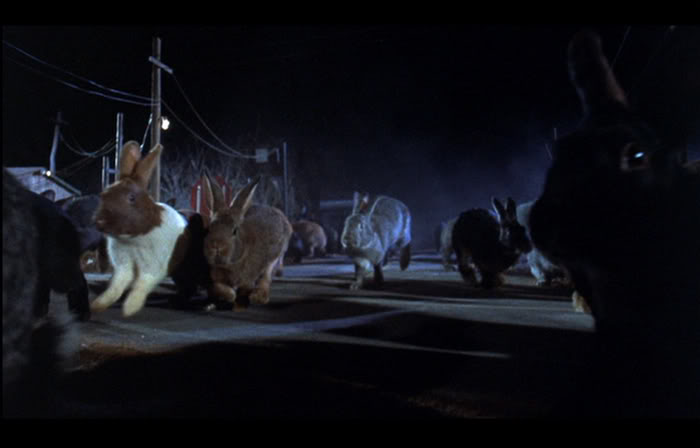
If the premise of rampaging, killer rabbits doesn’t elicit a giggle, the special effects will. The primary effect is accomplished by placing ordinary rabbits among miniatures and playing ominous music. Sometimes the rabbits stampede, and we are treated to countless scenes of colossal rabbits galloping in slow motion. To make matters worse, the rabbits don’t even appear to be wild, but more the household pet variety. There’s only so much terror a calico bunny can evoke. When a rabbit attacks an individual, a man in a rabbit suit is used. It looks almost as bad as it sounds.

Night of the Lepus does have some unsettling moments, however.  For example, the actual newsreel footage documenting the Australian rabbit plague of 1954, used at the outset of the movie, is a bit unnerving. Of course, our sympathy is more for the terror-stricken rabbits being herded and captured, than for the humans. Also, the film opens on a grim note when rancher Cole Hillman, played by Rory Calhoun shoots his horse after it breaks its leg in a rabbit hole. The reality of ranch life far outweighs the horror of gargantuan bunnies.

Another startling, if not shocking, aspect of the movie is the copious amounts of blood used. Granted, it is the phoniest type of movie blood, but there is a lot of it. Perhaps realizing the futility of scaring people with ferocious rabbits, Director Claxton decided to overcompensate with gore effects (which are also done poorly). Not only are the victims covered in it, but the red stuff is painted onto the rabbits’ paws and faces. Particularly look for the scene where Rory Calhoun shoots rabbits through the cellar floor.  The blood is positively gushing.

As for entertainment value, Night of the Lepus does have something. Unintentional humor seems to be its saving grace, but there’s a certain early 1970s allure that plays a role, too. It doesn’t have the charm of an Ed Wood, Jr. film, but something akin to it. It’s also amusing that the sheriff enlists the help of drive-in theater goers to wrangle the Herculean hares. I imagine a drive-in theater would have been the perfect venue for this flick.

Unfortunately, the movie drags too often for it to be a true treasure. It also features one of those annoying kids that cause a lot of problems. In this instance, it’s Melanie Fullerton in the role of Amanda Bennett. Amanda, in an attempt to save her favorite bunny, unintentionally releases an infected rabbit into the populace, which triggers the chain reaction. If B movies have taught me anything, it’s that little kids should not be allowed near labs where deadly research is being conducted. (Also see, The Monster that Challenged the World, for another example of a little girl unleashing havoc for the love of a rabbit.)

I’ve already mentioned Janet Leigh (in the role of Gerry Bennett) and Rory Calhoun (as Cole Hillman), but you will also recognize TV regular Stuart Whitman (who played uncredited bit parts in The Day the Earth Stood Still and When Worlds Collide)  as leading man, Roy Bennett; and DeForest Kelley (Dr. McCoy from TV’s Star Trek) as Elgin Clark. Mr. Kelley wears a moustache in this movie, but, unfortunately for him, he is still recognizable. This was DeForest Kelley’s last non-Star Trek role.

I’m giving Night of the Lepus extra points for its shear absurdity and unintentional humor, but it is probably one of those flicks you’ll enjoy more in the company of others. Bad movies just seem to be more fun in groups.

Scene to watch for: Cole Hillman (Rory Calhoun) demonstrates a unique hitchhiking technique by standing on the side of the road and waving his rifle above his head like a madman.

Line to listen for: “But doctor, rabbits as big and as ferocious as wolves? It isn’t conceivable!”

Mark’s Rating! ! ! out of 5.

Earth vs the Flying Saucers (1956)

From the video case:

Featuring extraordinary special effects by cinematic genius Ray Harryhausen, the film pits earthlings against alien humanoids in a violent battle for earth’s survival! When the zombie-like aliens arrive at the U.S. army base in search of help for their dying planet, they try to make friendly contact with scientist Dr. Russ Marvin (Hugh Marlowe) and his recent bride, Carol (Joan Taylor). But the military greets their fleet of saucers with gunfire and the the aliens are forced to retaliate. Can Marvin invent the ultimate weapon in a deadly game of beat-the-clock to save the human race? (1956, b&w)

Mark says:

Any film featuring the special effects of Ray Harryhausen (The Beast from 20,000 Fathoms) is going to rank with me. The flying saucers are definitely the main draw here, and place this otherwise camp picture a peg higher. Stop motion animation will beat out CGI effects in my book any day.

The acting and dialog in this film are substandard, but amusing enough to make the movie enjoyable. I especially think the amorous Hugh Marlowe (Dr. Marvin) is a mismatch for the demure Joan Taylor (Carol).

Morris Ankrum (of course!) plays an army general, and B-stock veteran, Tom Browne Henry, has a featured role.

The aliens, as well as many of the “scientific” principles introduced in the movie, are laughable. I am also amused by some of the advanced technology, such as a computer that writes in cursive when transmitting its message.

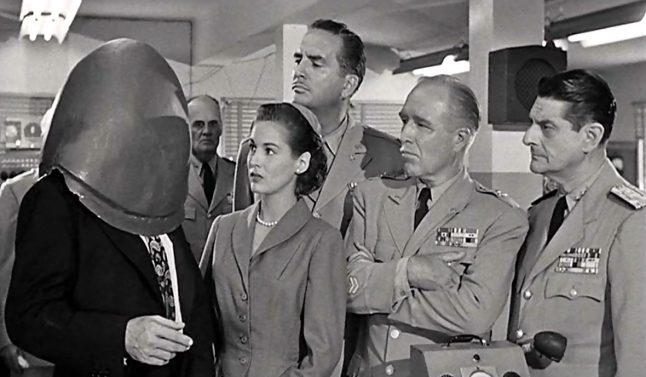
Hugh Marlowe tries on an alien helmet while everyone else keeps a straight face.

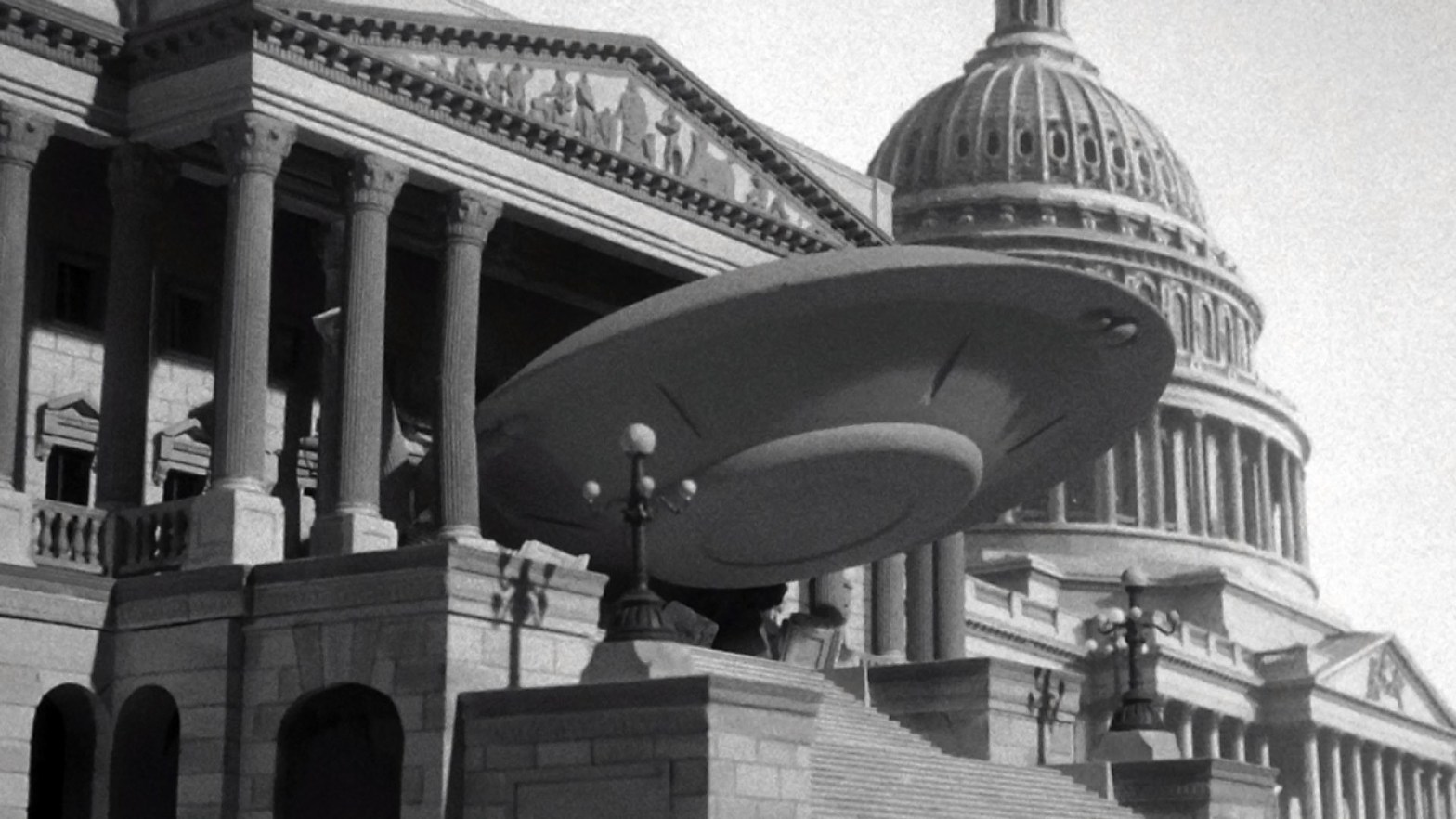
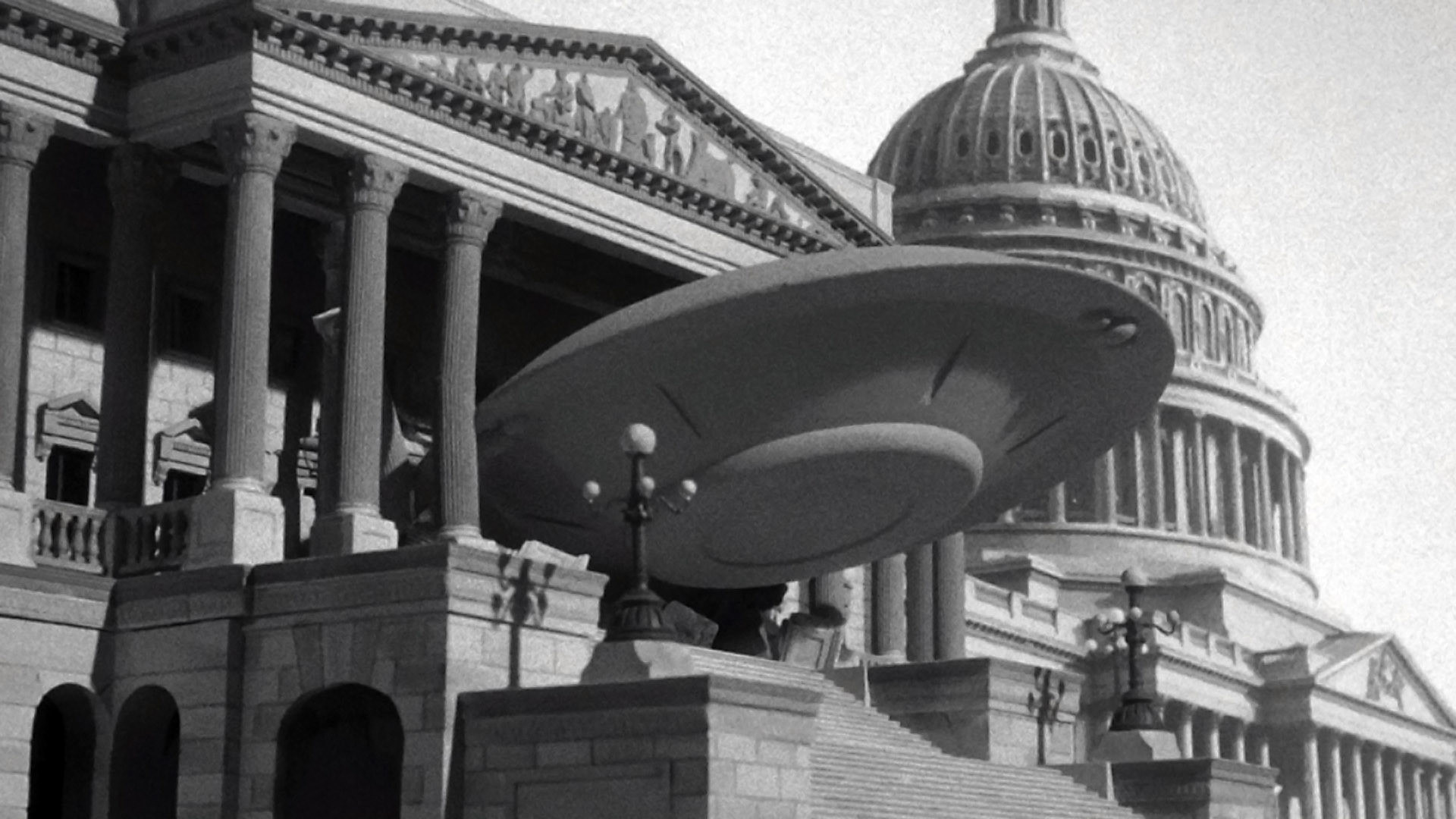
A combination of low-budget humor, and wonderful effects created by Ray Harryhausen (especially the climatic battle scenes in Washington, DC), make this a thoroughly watchable film.

Earth vs. the Flying Saucers is directed by Fred F. Sears.

Scene to watch for: Hugh Marlowe tries on an alien helmet and looks like a drunk with a plastic garbage pail on his head.

Line to listen for: “When an armed and threatening power lands uninvited in our capitol, we don’t meet it with tea and cookies!”

Mark’s Rating! ! ! ½ out of 5.

I Was A Teenage Werewolf (1957)

From the video case:

Michael Landon made his first starring role one to remember. He brings a fierce intensity to the role of Tony, a likable high-schooler prone to outbursts of violence. A psychiatrist (Whit Bissell) treats Tony for his aggression, but the treatment is worse than the disease. Tony becomes a werewolf and begins a murderous spree that makes his past behavior look like a stroll in the park. (1957, b&w)

Mark says:

This was an incredibly successful film (grossing ten times its cost within a year of release) and is credited for the string of “I Was A Teenage Fill-In-The-Blank” movies that followed. It’s a delightfully cheesy peek into the 1950s adolescent mindset.

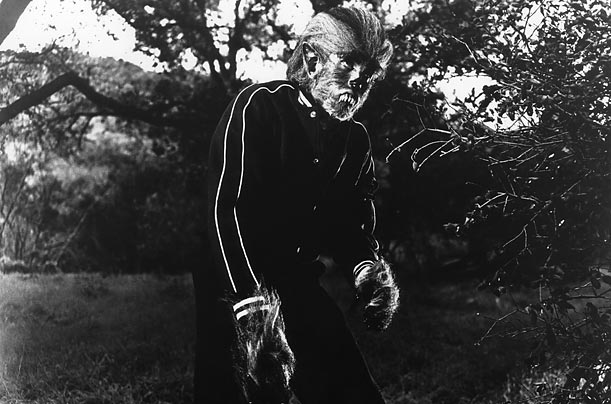
Michael Landon plays Tony Rivers, an angst-ridden, teenage boy. He fights, he loves, he plays pranks, and fights some more. He’s half-way to being a werewolf already when he is sent to Dr. Brandon, played by B-movie regular, Whit Bissell (Creature from the Black LagoonMonster on the Campus) who is supposed to help him with his anger issues.

Little does anyone know that Dr. Brandon has a plan to hurl mankind back into it’s “primitive dawn” so humans can start all over. Through drugs and hypnotic regression, he transforms Tony into a hairy boy-beast who chomps down on his teenage friends and wrestles with a German Shepard, all without ever having to take off his school jacket.

Both Landon and Bissell play their parts with gusto, which gives this film most of its charm, and there is some great 1950s slang that proves entertaining when the movie hits slower moments. Teenage Werewolf also features a singing-dance number which is sufficiently cheesy enough to be engaging.

This picture is directed by Gene Fowler, Jr., who directed the equally campy titled, I Married A Monster from Outer Space.

Scene to watch for: Tony gets very angry at a bottle of milk.

Line to listen for: “I amuse myself with fantasy. I live by facts.”

Mark’s Rating! ! ! out of 5.

Them! (1954)

From the DVD case

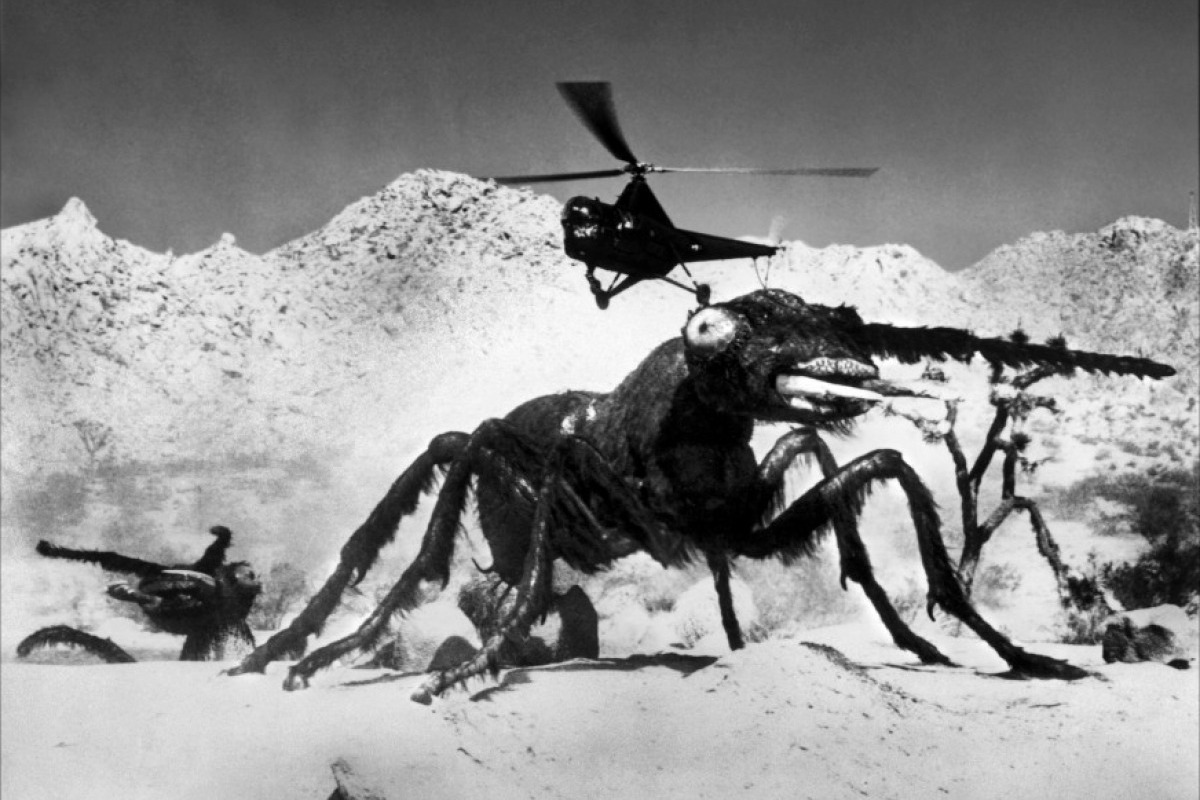
Them! is a landmark movie about giant radiation-mutated ants that gets better with age and boasts remarkable, Academy Award-nominated special effects. Starring James Whitmore, James Arness and Edmund Gwenn, Them! begins in New Mexico with a child wandering in shock, a ransacked general store and a battered corpse full of enough formic acid to kill 20 men. It ends with an epic struggle in the 700 miles of storm drains under Los Angeles, where the insect hordes are beaten. But they’re not conquered because they spawned a generation of films about radioactive creatures. Some approximate the terror but few have equaled the artistry of Them! (1954, b&w)

Mark says

Them! rates at least a few notches higher than your standard giant bug flick for its intelligent dialog and above par acting. It’s also the original radiation-mutated monster movie. Today, many aspects of the film seem cliche, but that’s only because Them! has been emulated so often.

This film is as much of a detective movie as it is a creature feature. Usually, the sleuth portion of the film is just as interesting as the battles with the mutated creatures.

I’ve often wished I could watch Them! without previous knowledge of it being a film about giant ants. That way I could enjoy the picture unfold as it reveals its terrible secret. But even with foreknowledge, this movie manages to hold our interest.

My biggest complaint about the film is the character played by Edmund Gwenn, Dr. Harold Medford. I just don’t think he portrays the part well. Dr. Medford is a cranky and annoying old man, which does not help endear him to the viewer, though I think it is supposed to give him a lovable quality.

Luckily, James Whitmore and James Arness (The Thing from Another World) play their parts without any monster movie campiness, and this proves to be a great boon to the film.

Joan Weldon plays the strong-willed scientist, Dr. Patricia Medford, and gives us an early glimpse into what the women’s movement was all about.

Them! is one of my favorite giant bug/animal pictures, and it gets bonus points for being a prototype for so many films that followed. I also give it credit for killing off one of the major stars in the final battle scene.

This film is directed by Gordon Douglas.

Scene to watch for: A very young Leonard Nimoy plays an Air Force sergeant. You’ll have to be on your toes, though. His onscreen time is brief, and he only gets a few lines.

Line to listen for: “Boy, if I can still raise an arm when we get out of this place, I’m going to show you how well-saturated I can get!”

Mark’s Rating! ! ! ! out of 5.
The War of the Worlds (1953)

From the DVD case:

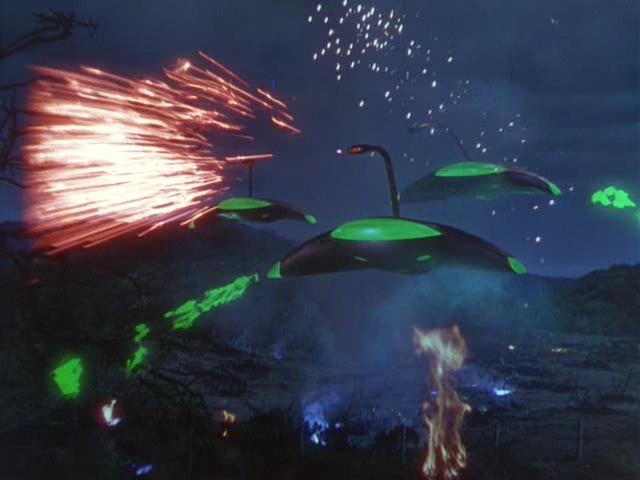
H.G. Wells’ chilling novel of a Martian invasion of Earth becomes even more frightening in this 1953 film adaptation that’s widely regarded as one of the greatest sci-fi movies of all time. An Oscar winner for Best Special Effects, The War of the Worlds delivers eye-popping thrills, laser-hot action and unrelenting, edge-of-your-seat suspense. No one who has seen the film’s depiction of the swan-shaped Martian machines – ticking and hissing menacingly as they cut their path of destruction – will ever forget their ominous impact. (1953, color)

Mark says:

It would be hard to estimate how many times I’ve watched The War of the Worlds. This George Pal production was not only a favorite when I was a kid, but it still holds its charm these 50 plus years later.

Gene Barry plays the male lead, Dr. Clayton Forrester, a scientist on the scene when the first spacecraft lands. Ann Robinson plays pretty Sylvia Van Buren, the love interest. I’m still amazed that Miss Robinson was only seventeen years old when this movie was made.

I admit that The War of the Worlds can get a little corny at times, and it certainly won’t inspire the panic Orson Welles’ 1938 radio broadcast created, but it still holds its own when it comes to plot and production values. Of course, when you base a movie on a novel by H.G. Wells and then have George Pal (Destination MoonWhen Worlds Collide) produce it, you really can’t go wrong.

The War of the Worlds is a visually fascinating film. I love the vivid colors, the shape of the Martian war machines, Los Angeles in flames, and the distinct feel of a 1950s America. Some of my favorite scenes:

1. A Martian war machine slides into a rural farmhouse upon landing.

2. Dr. Forrester and Sylvia are trapped in the farmhouse, and a Martian surprises Sylvia by placing its creepy, tentacled hand on her shoulder.

3. LA is under attack and we see a church silhouetted by a burning sky.

Still, there are a few laughable moments. For instance, when we see the firefighters battling the fire started by the first spaceship, they are using what amounts to squirt guns and jackets to fight the flames.

Also, the Martians themselves (though possessing creepy arms and hands) look rather ridiculous when we see them in their full glory. Of course, the main focus is on the Martian machines, and the few scenes where the Martians are viewed fully can be forgiven.

The War of the Worlds also stars Les Tremayne (The Monolith MonstersThe Angry Red Planet) as Maj. Gen. Mann.

Directed by Byron Haskin (Conquest of SpaceRobinson Crusoe on Mars).

Scene to watch for: Three yokels form a welcoming committee only to find the Martians are less than gracious guests.

Line to listen for: “The end came swiftly. All over the world, their machines began to stop and fall. After all that men could do had failed, the Martians were destroyed and humanity was saved by the littlest things, which God, in His wisdom, had put upon this Earth.”

Trivia: The H.G. Wells’ estate was so impressed with The War of the Worlds that George Pal was offered his choice of any other Wells’ property. The result was 1960’s The Time Machine.

Mark’s Rating! ! ! ! ! out of 5.

The Four Skulls of Jonathan Drake (1959)

From the DVD case:

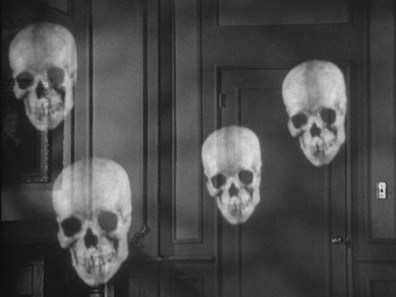
The sins of the fathers rest heavily on the heads of the sons – literally – in this fun-filled frightfest that’ll keep you awake and screaming through many a traumatic night. Faced with an age-old family curse that beheaded their forefathers, two brothers attempt to unravel the family plot, even as sinister forces attempt to put them into it! (1959, b&w)

Mark says:

 The Four Skulls of Jonathan Drake was an unknown film to me until a DVD (paired with Voodoo Island) from MGM’s Midnite Movies was released. When I noticed what amateur reviewers were writing at IMDb and Amazon, I started to take an interest. Apparently Four Skulls traumatized many a youthful audience member when it was first released. When a reader wrote me with a similar story concerning his history with the film, I knew I had to give it a view.

The DVD description is not quite accurate, and deserves some clarification. Jonathan Drake is the descendant of a man responsible for a massacre of an Amazonian tribe known as the Jivaro Indians, approximately 180 years ago. Drake’s ancestor (Wilfred Drake) slaughtered every man and male child of the tribe except for the tribal witch doctor, who escaped. The witch doctor placed a curse on the Drake family. Ever since, every male member of the Drake family, at the age of 60, succumbs to death and, more mysteriously, their heads are always removed before entombment. The skulls are eventually returned to the family tomb after each death. It is important to note that the Jivaro Indians are famous for their practice of shrinking heads.

Jonathan Drake, portrayed by Eduard Franz (The Thing from Another World), is a man who has dedicated his life to the occult in an attempt to understand the curse and hopefully avoid its consequences. Jonathan’s 60 year old brother, Kenneth (Paul Cavanagh, She Devil, 1953’s House of Wax), has recently succumbed to the curse, and as tradition dictates, his corpse was entombed without its head. Unfortunately, throughout most of the picture, Jonathan is either in a trance or going into shock every ten minutes. It’s not until the final reel that he pulls himself together enough to be effective in any real way. Apparently, Jonathan and his brother were very close in age, as Jonathan is also 60 years old at the outset of the story.

Valerie French plays Jonathan’s daughter, Alison Drake. Valerie is sort of an Allison Hayes-type character, but without the edge. She is pretty, but not much more than window dressing. She plays a semi-love interest to the story’s hero, but I’ll discuss that later.

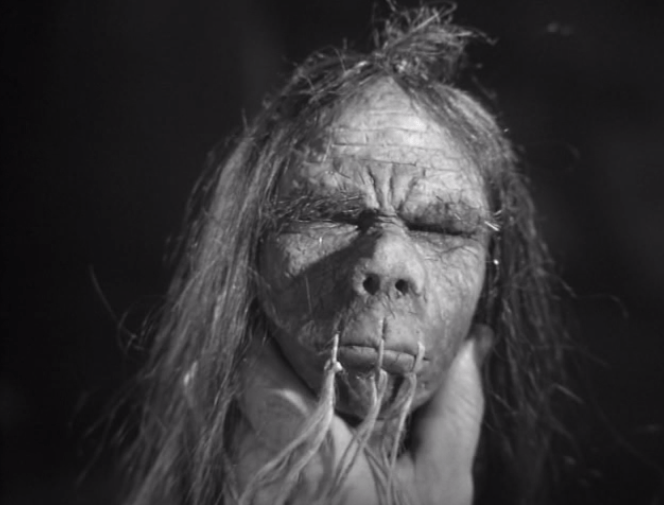
Before I bore you with any more character analysis, let me tell you why I place this movie a notch above some of the other films of its time and genre. What struck me immediately was the explicit process in which the head shrinking was demonstrated. Though this portion may have slowed the picture down, I have to admit that I found it fascinating. The skull is removed from the head and the fleshy part (face, scalp, etc) is processed in a vat of boiling liquid. Then the eyes, nose, and mouth are sewn shut. The head is then filled with hot sand and the shrinking process is commenced. Though we don’t get a lot of blood, the process itself is unsettling. The detached head props are realistically portrayed and the final results of the shrunken heads are appropriately freakish.

Zutai

Another disturbing aspect of the film is the character, Zutai, played by Paul Wexler. Zutai is an immortal creature created through an ancient Jivaro process. To prove that he is one of the immortals, his mouth is sewn shut to demonstrate that he does not have to eat to survive. Of course, this renders his character mute, too. Zutai, we discover, is the witch doctor’s assistant, who does most of the dirty work. First he renders his victims helpless by poisoning them, and then he removes their heads. He never seems able to complete his task on the first try, but the sight of his lips sewn shut is enough to give his character an adequately creepy demeanor.

Dr. Zurich

The true villain of our story is Dr. Emil Zurich, played by Henry Daniell (The Body SnatcherVoyage to the Bottom of the Sea). Dr. Zurich is thoroughly sinister. We are right to suspect him right from the beginning when he refuses to shake hands with the inspector. Dr. Zurich has a macabre secret which I won’t reveal out of respect for the uninitiated.

Our story’s hero is the ultra-serious Lt. Jeff Rowan (Grant Richards). Though none of the performances in Four Skulls are extraordinary, I find Richards portrayal of Lt. Rowan particularly below par. His role requires him to be a “nothing but the facts” kind of guy, but he comes off as stiff and seems out of place among the cast. A sort of romance develops between Rowan and Drake’s daughter, but the chemistry is awkward at best. Fortunately, the film does not linger on this angle long and we are spared the embrace and kiss at the film’s conclusion.

The plot is littered with flaws, some more noticeable than others. Genre enthusiast, Paul Bollenbacher, sent me a list of goofs he noted. One flaw he noted concerns a discrepancy in dates:

If every male member of the Drake family dies of decapitation at age 60, it’s impossible for the curse to be almost 200 years old. After Drake and his daughter enter the family crypt, we see plaques on the wall for each of the Drake men. Wilfred Drake’s, the captain who headed the rescue team to save the Swiss doctor which lead to the curse, is dated 1813-1873. Gilbert Drake, Jonathan’s grandfather, is dated 1843-1903. Jonathan’s father, David W. Drake, is dated 1873-1933. Finally his brother, Kenneth, is dated 1898-1958. Yet later, when they talk about the failed rescue, they say it happened 180 years ago. Since this movie takes place in 1958, confirmed by Kenneth’s grave plaque, that would mean the fateful mission happened around 1778, or 35 years before Capt. Wilfred Drake was even born!

Even with the numerous plot holes, it’s easy to see why this movie had such an impact on the people who remember it. The Four Skulls of Jonathan Drake was an unusual film for its time, with imagery that was sure to leave an indelible impression on the young audience that viewed it. Is it a “forgotten classic?” Hardly. But it’s certainly good entertainment for genre fans who crave something a little different.

Directed by Edward L. Cahn (Invisible InvadersZombies of Mora Tau) and written by Orville H. Hampton (The Alligator PeopleThe Atomic Submarine).

Scene to watch for: Jonathan Drake opens his brother’s casket only to find his headless corpse.

Line to listen for: “Your brother’s face, sir, we thought it better to keep the coffin closed.”

Mark’s Rating! ! ! out of 5.
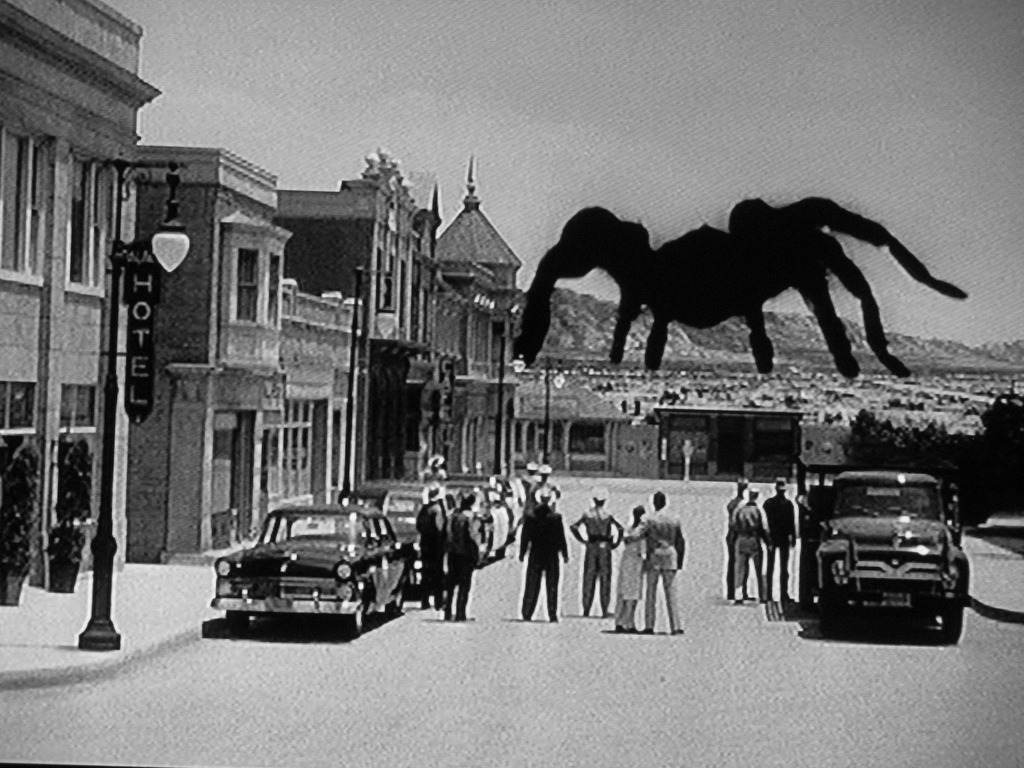
The Beast of Yucca Flats (1961)

Tor Johnson is the Beast of Yucca Flats

From the DVD case:

Fans of The Incredible Hulk will love this early sixties horror film. After accidentally being exposed to a dose of atomic radiation, a Russian scientist’s body undergoes massive transformation. With this ill-tempered monster out to reek havoc on the world, is anyone safe? (1961, b&w)

Mark says

The Beast of Yucca Flats is as close as you can get to an Ed Wood movie without actually being an Ed Wood movie. It has a ridiculous plot line, cheesy narration, wooden acting, and features Ed Wood regular Tor Johnson (Bride of the MonsterPlan 9 from Outer Space) in a starring role. Still, Beast of Yucca Flats fails to capture that certain Ed Woodian charm.

The movie’s most obvious flaw is its lack of dialog. The entire story is told through the narration of writer/director Coleman Francis. What little dialog we do hear was obviously dubbed in later, and not very well at that. It seems the most creative efforts were devoted to obscuring the characters’ faces as they spoke.

There is amusement value to be found in the narration, though. Incredibly silly lines are expressed with deadly seriousness. For example, as a man relaxes on a cot: “Nothing bothers some people, not even flying saucers.” This might make sense if the movie had anything to do with flying saucers, but it doesn’t.

The storyline is fairly standard, but silly. Tor Johnson plays brilliant Russian scientist, Joseph Javorsky. So right away our suspension of disbelief is stretched to its limits.

After one of the most boring car chases in cinematic history, Javorsky is transformed into a mindless, killing beast via a nuclear explosion. He still looks like Tor Johnson, but his shirt is ripped and he has some goop on his face. He then strangles a husband and wife and is pursued through the desert by a pair of dedicated patrolmen.

I’m actually making it sound more exciting than it is. For a film of merely 54 minutes, it feels much longer. Much, much longer.

The Beast of Yucca Flats desperately tries to impart a message to us, but we’re never sure what that message is. It seems to take an anti-progress stand (and the filming technique reinforces this theme) but its hard to tell what to make of lines like: “In the blistering desert heat, Jim and Joe plan their next attack. Find the Beast and kill him. Kill, or be killed. Man’s inhumanity to man.” Everything is said as if it is very important, but nothing fits together.

Speaking of things not fitting together, the opening scene is a complete mystery. A woman towels off after a bath (there’s actually some very brief and awkward nudity) and then Tor appears and strangles her.

What’s so perplexing is that this scene takes place before Tor is transformed into the beast. It is also filmed indoors, while the rest of the movie is set in the desert. My guess is that the nudity is a ploy to capture the viewer’s attention, but the overall effect is clumsy and utterly confounding.

I’m giving Beast of Yucca Flats a few points for its amusing narration, but I can only recommend this film to hardcore B-movie enthusiasts. Even then, it’s not a hearty recommendation.

Despite what the DVD description above says, fans of The Incredible Hulk will not love this film.

Scene to watch for: Never say, “Shoot first and ask questions later,” to Jim Archer unless you mean it.

Line to listen for: “Boys from the city, not yet caught by the whirlwind of Progress, feed soda pop to the thirsty pigs.”

Trivia: That cute little bunny scene at the end was completely improvised when a rabbit just happened to hop onto the set. I think it was attracted to the goop on Tor Johnson’s face.

Mark’s Rating! ½ out of 5.

The Blob (1958)

From the DVD case:

One of the great cult classics, The Blob melds ’50s schlock sci-fi and teen delinquency pics even as it transcends these genres with strong performances and ingenious special effects. Made outside of Hollywood by a maverick film distributor, a crew experienced in religious and educational shorts, and a collection of theatrical talent from Philadelphia and New York, The Blobhelped launch the careers of superstud Steve McQueen and composer Burt Bacharach. (1958, color)

Mark says:

There’s something about the simplicity of The Blob that endeared this movie to me as a child. A meteor falls from space, breaks open, and a gray gooey substance emerges. The goo, once attached to a human, ingests the flesh, blood, and bone (turning red in the process) and grows a little bigger. The more people it ingests the larger it gets.

A group of local teenagers are the first to encounter The Blob (excluding the adults who have already been devoured by the thing), but because they are only teenagers, they have a difficult time convincing authorities of the threat. A great deal of the film involves the teens trying to persuade and warn the adult population of the growing menace. Unfortunately, the only menace the townsfolk will acknowledge are the teenagers.

As a preteen I was intrigued by the idea that the kids were the heroes. The adults (parents, police, etc) are well-meaning, but it’s the teenagers who convince the populace of the problem, and ultimately, the teenagers are the ones who arrive at a solution to defeat the monster. I wasn’t a teenager yet, but I soon would be, and this notion was something I could really sink my teeth into.

Steve McQueen, in an early role, plays Steve Andrews, a sensitive and misunderstood teenager. It should be noted that McQueen was 27 years old during the filming of this picture, and rather looks it. But McQueen plays the part so well that he makes the other (real) teenagers seem like actors.

Steve’s girlfriend, Jane, is played by Aneta Corsaut (you’ll remember her as Miss Crump from The Andy Griffith Show). Aneta is also a rather old looking teenager (she was 23 at the time of shooting), but she conveys a certain vulnerability that almost makes her believable.

The rest of the gang is portrayed by Robert Fields, Anthony Franke, and James Bonnet (in the roles of Tony, Al, and Mooch, respectively). Their performances seem amateurish, and only Robert Fields (1975’s The Stepford Wives) went on to anything that could be called a film career.

Jane’s little brother, Danny, is played by Kieth Almoney. Danny may be the most obnoxious child ever portrayed in cinematic history. Luckily, Danny does not get a lot of screen time.

Olin Howlin

The Blob does feature some veteran actors, though. Olin Howlin (Them!The Return of Doctor X) was a veteran of over 150 films. He plays the Old Man and is The Blob’s first victim. This would be Mr. Howlin’s last picture; he passed away in 1959. You may also recognize Steven Chase (When Worlds Collide) in the role of Dr. T. Hallen.

The Blob was an independent production (picked up by Paramount), filmed far from Hollywood, in and around Valley Forge, Pennsylvania. This non-Hollywood locale gives the film a genuine small-town feel, and a unique flavor as far as sci-fi pictures of the era go. I’m particularly impressed with the powerful colors (they vaguely remind me of the strong color scheme in War of the Worlds).

The special effects for The Blob were created by Bart Sloane. His technique of using tiny sets, photographs, and a hydraulic lift to put The Blob in motion are quite effective. If you purchase the Criterion Collection release of this DVD, be sure to check out the stills of Sloane performing his magic.

In the early portion of the film, the shots of the monster were achieved by using a modified weather balloon. Later, colored silicone gel was used to achieve the illusion. The monster is never truly scary, but it is interesting to watch. The only remotely suspenseful scenes are when Steve and Jane are trapped in the supermarket cooler, and then again when they are trapped in the basement of the diner.

You can’t talk about The Blob without mentioning the opening theme song, written by Burt Bacharach. It’s so goofy and out of place for a sci-fi/horror flick that you are taken off-guard on first viewing. Somehow, though, after watching the film, the song seems more appropriate. Finally, after several viewings, you can’t imagine any music more fitting.

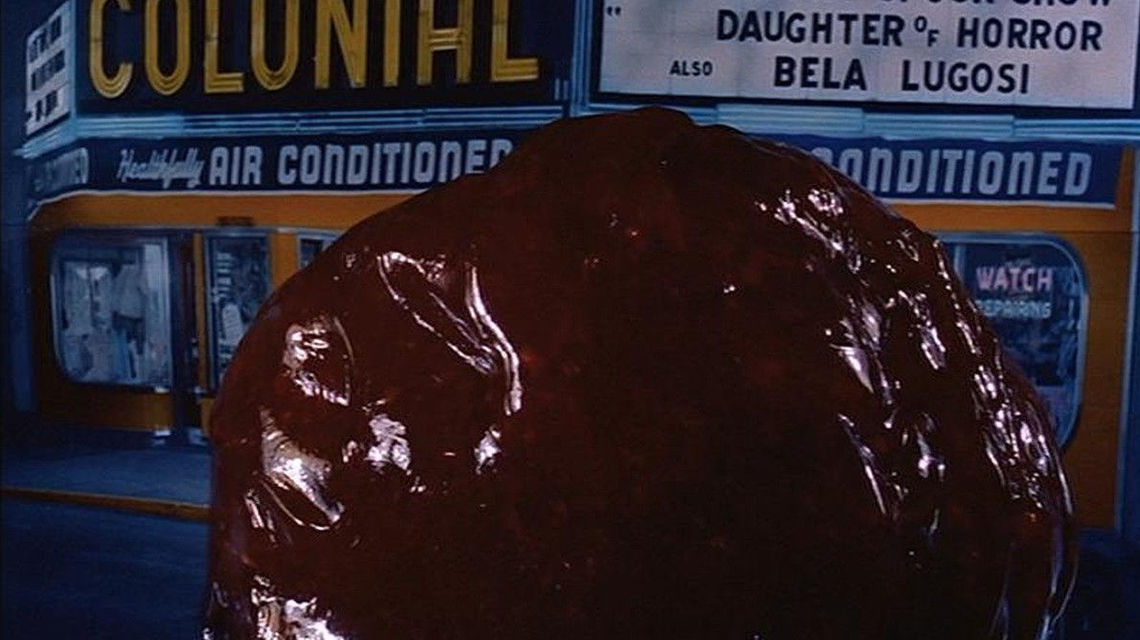
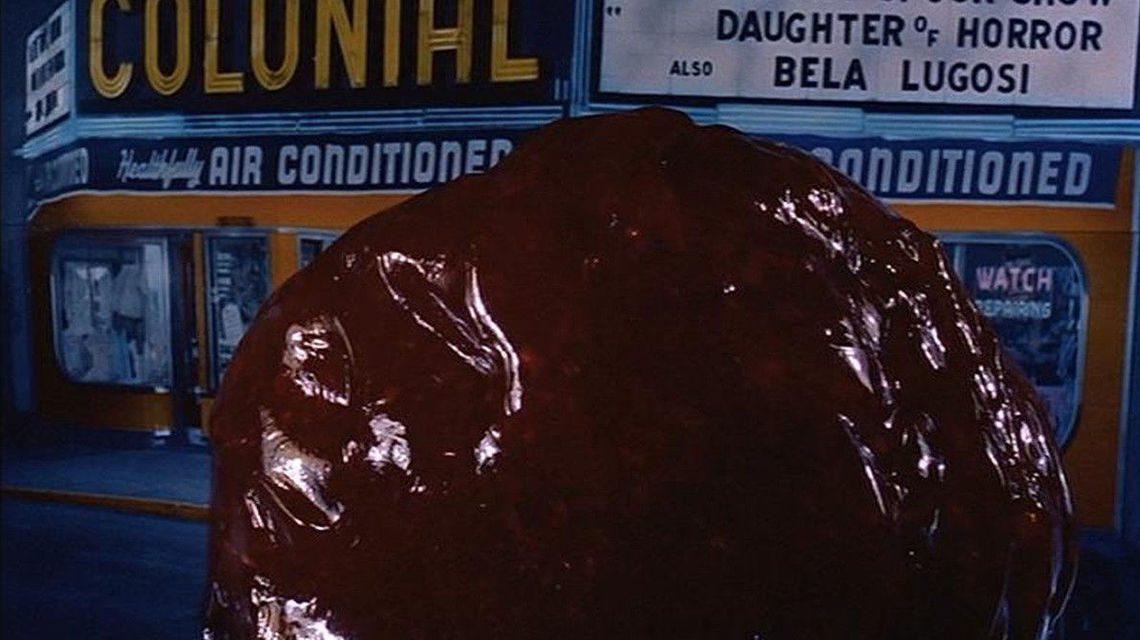
A key sequence of the film features The Blob attacking patrons at a midnight spook show. This must have been great fun for audiences watching the film in an actual theater. By the way, the film playing as The Blob descends on the crowd is Daughter of Horror (aka Dementia), narrated by famous Johnny Carson sidekick, Ed McMahon.

The Blob is certainly a favorite movie from my youth. The monster, McQueen’s acting, the teenage delinquent theme, and the overall unusual look and feel of the film, make it a genuinely good time.

Director Irvin S. Yeaworth Jr., with the success of The Blob, was able to go on and direct another sci-fi oddity, 4D Man, the following year.

Scene to watch for: Watch closely after Steve sneaks out of his house to talk with Jane. As their conversation is concluding there is a shot of Steve speaking earnestly to Jane. You’ll notice some smoke rising over McQueen’s left shoulder. That smoke is from a cigarette McQueen was hiding behind his back while they filmed the shot.

Line to listen for: “Maybe the thing you saw was a . . . a monster?”

Trivia: Steve McQueen was originally signed for a three picture deal, but he was so difficult to work with that the producers released him from his contract for the other two movies.

Recommendation: If you can get your hands on the Criterion Collection release of this DVD, I highly recommend picking it up. It is an amazing transfer with clear, crisp colors and well-balanced sound, not to mention several other perks (including a special collectible poster).

Mark’s Rating! ! ! ! out of 5.
Kingdom of the Spiders (1977)

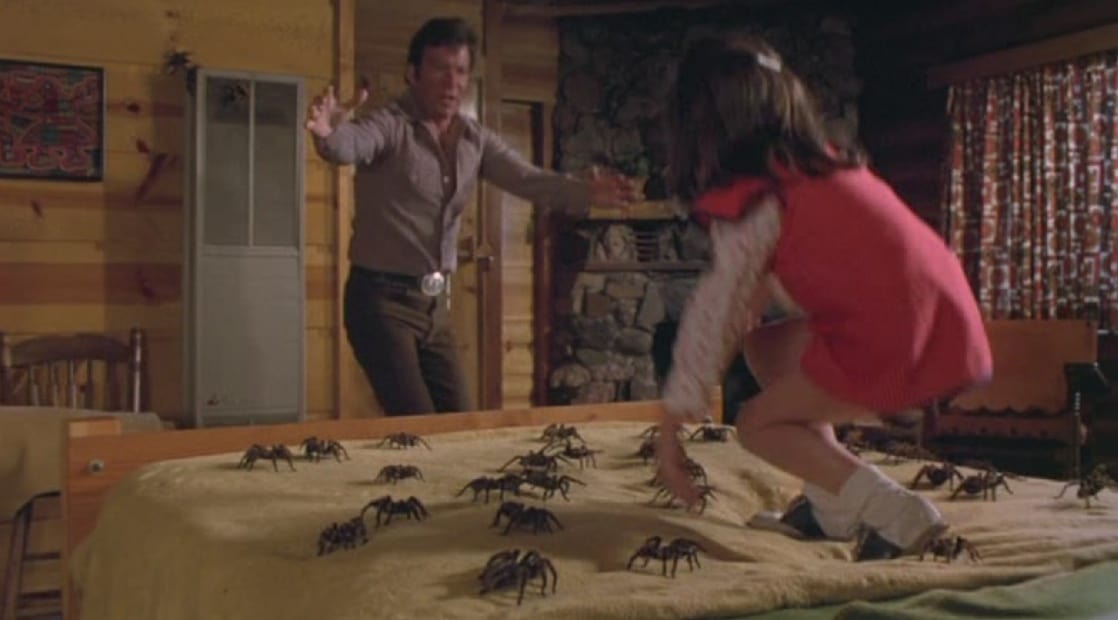
William Shatner in a scene from Kingdom of the Spiders

From the DVD case:

William Shatner stars as veterinarian “Rack” Hanson in this cult classic about an Arizona town infested with eight-legged killers, which turn on the humans whose insecticides have depleted their normal food supply. Woody Strode is Rack’s friend, rancher Walter Colby, whose livestock first fall victim to the angry arachnids. Entomologist Diane Ashley (Tiffany Bolling) arrives and tries to help Rack deal with the crisis, but with the big county fair fast approaching, Mayor Connors (Roy Engel) refuses to let them quarantine Colby’s ranch. Soon, the remaining residents are barricaded at Emma Washburn’s (Lieux Dressler) lodge, fighting for their very lives, in this skin-crawling chiller featuring Shatner’s then-wife, Marcy Lafferty, as his sister-in-law, Terry. (1977, color)

Mark says:

It would be easy to dismiss Kingdom of the Spiders as another schlocky 70’s B-movie, except for the fact that so many of the scenes are genuinely creepy. Viewers ultimately find themselves laughing and cringing throughout the picture. Though the acting is what you’d expect from a low-budget production, I have to give the cast credit: almost all of those spiders crawling on them are real tarantulas. Reportedly, 5,000 of the creatures were wrangled for the film.

Kingdom of the Spiders features a strange love triangle between “Rack” Hansen (William Shatner), his late brother’s wife, Terry Hansen (Marcy Lafferty), and entomologist, Diane Ashley (Tiffany Bolling). Though Shatner is supposed to be a macho, witty, irresistible, down-home fellow, he comes off as rather lecherous. Rack’s amorous interludes with his sister-in-law are particularly disturbing.

Another oddity regarding Kingdom of the Spiders is the unusual choice of theme song. Country singer Dorsey Burnette croons these strangely inappropriate lyrics during the horrific conclusion of the film: “Will tomorrow bring the love we need to last forever more? Or could it bring the unknown that we’ve never seen before?” It’s such a curious juxtaposition of visual and song that you could almost mistake it for avant-garde cinema. Of course, we know better.

The true stars of this picture, though, are the tarantulas. Unlike Tarantula or Earth vs The Spider, these arachnids don’t grow to gigantic proportions; their numbers and natural bulk are enough to provide the menace. They seem to be endowed with an unnatural sense of intelligence. For example, they know they have to band together if they are going to conquer the human population. They are also smart enough to attack a crop-duster (in mid-flight!) as he sprays the area with DDT. And just in case you didn’t catch it the first time: they’re real!

Though Kingdom of the Spiders is an awkward blend of romance, spiders, and music, it does hold enough suspense and entertainment value to keep your attention. It’s especially fun to watch with an arachnophobic friend.

Directed by John ‘Bud’ Cardos.

Scene to watch for: A living mass of spiders crawl and writhe beneath a little girl (Natasha Ryan) as she swings just inches above them.

Line to listen for: “You don’t quit pestering me, one of these mornings I’m gonna show up and start milking that cow.”

Trivia: The American Society for the Prevention of Cruelty to Animals (ASPCA) would never approve this film today. Many of the 5,000 tarantulas are squashed, sprayed with fire extinguishers, and/or otherwise brought to their demise onscreen.

Mark’s Rating! ! ! out of 5.
The Thing from Another World (1951)

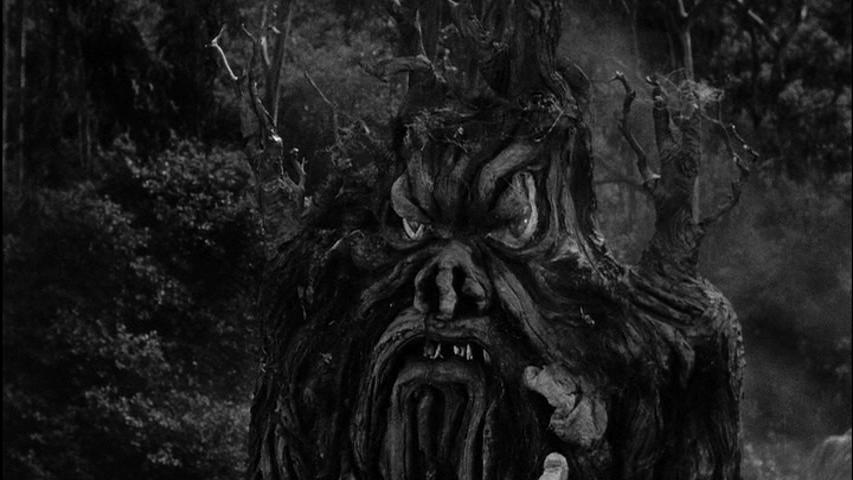
James Arness as The Thing

From the DVD case:

Arctic researchers discover a huge, frozen spaceling inside a crash-landed UFO, then fight for their lives after the murderous being (a pre-Gunsmoke James Arness) emerges from icy captivity. Will other creatures soon follow? The famed final words of this film are both warning and answer: “Keep watching the skies!” (1951, b&w)

Mark says:

It would be difficult to find a vintage sci-fi movie enthusiast who doesn’t rate this film as one of his favorites. Not only is it a fantastic story (based on John W. Campbell Jr’s Who Goes There?) but it is supported with capable acting and excellent overlapping dialog that keeps the plot moving. The Arctic setting gives the film a powerful sense of isolation, even more than the desert motif used in many later films of the genre.

Kenneth Tobey (It Came from Beneath the SeaThe Beast From 20,000 Fathoms) stars as competent military man, Captain Patrick Hendry. This is easily my favorite role for Tobey. He is so strong in his portrayal that a myriad of sci-fi films of the 50s also incorporated “Tobey-type” military heroes into their stories.

Capt. Hendry’s love interest is Margaret Sheridan playing the role of Nikki. She’s smart and courageous and a fine match for the Captain.

Douglas Spencer (This Island Earth) is Scotty, a newspaper man. Spencer gets some of the best lines in the film, including the famous warning at the conclusion.

Robert Cornthwaite (The War of the Worlds) is the lead scientist, and generally unlikable guy, Dr. Carrington. His passion for science and knowledge puts the entire party at risk. In his own words, “Knowledge is more important than life.”

James Arness (Them!) plays The Thing. Special effects for the creature are unimpressive, but the film compensates by not showing clear shots of the monster. Rather than detracting from the picture, this adds to the mystery of the beast. It also helps build the already superb use of suspense established in the movie.

You will recognize several of the other cast from sci-fi films made later. Of special note is Paul Frees in the role of Dr. Vorhees. If his face doesn’t look familiar, you’ll remember his voice work in such sci-fi classics as Earth vs. the Flying Saucers and The War of the Worlds.

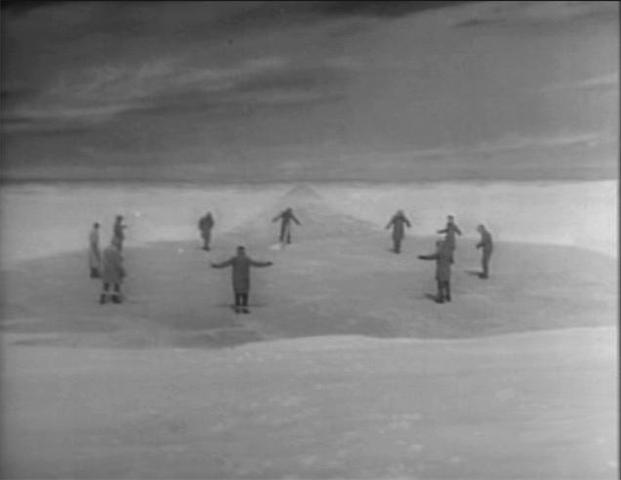
It has always been my feeling that one of the great moments in sci-fi movie history is when the exploration party spread out to determine the size and shape of the craft they find under the ice. That silent moment when they realize they’ve discovered a flying saucer is pure science-fiction gold.

Of all the sci-fi/horror films of the 1950s, The Thing from Another World really withstands the test of time. You’d be doing yourself an injustice not to see it.

Directed by Howard Hawks and Christian Nyby.

Scene to watch for: Margaret Sheridan (Nikki) ties Kenneth Tobey’s (Capt. Hendry) hands behind his back so she can share a drink with him without getting pawed.

Line to listen for: “Watch the skies, everywhere! Keep looking. Keep watching the skies!”

BonusRead the script.

Personal note: John Carpenter’s remake of this film, The Thing (1982), is one of the few remakes I like as much as the original. They are quite different films, but I highly recommend both.

Mark’s Rating! ! ! ! ! out of 5.
Tarantula (1955)

From the video case:

Biochemist Leo G. Carroll has a plan to feed the world by using a growth formula on plants and animals. But instead he creates a spider of mammoth proportions with an appetite to match!

Feeding off cattle and humans, this towering tarantula has the people of Desert Rock, Arizona, running for their lives. Can this horrible creature be stopped? Or will the world succumb to this over-sized arachnid? Starring John Agar as the good doctor and Mara Corday as a student, and potential victim, of this science experiment gone awry! (1955, b&w)

Mark says:

I’ve always been a sucker for big bug flicks, and this is one of my favorites. Strong direction by Jack Arnold (Creature from the Black LagoonThe Incredible Shrinking Man) is enhanced by the B-movie star power of John Agar (Invisible InvadersThe Brain from Planet Arous), Mara Corday (The Black Scorpion), and Leo G. Carroll who plays crotchety Prof. Gerald Deemer.

John Agar is at his best as Dr. Matt Hastings, a young country doc trying to unravel the bizarre happenings in his small desert community. Mara Corday plays Stephanie ‘Steve’ Clayton, an aspiring scientist and love interest for Dr. Hastings. This is my favorite role for Mara Corday. She plays the part with sophistication and charm, and can scream with the best of them.

You may also recognize B-movie regular Hank Patterson (Monster on the CampusBeginning of the End) as Josh, the hotel clerk. I always remember him as Fred Ziffel from the tv series Green Acres. He is used primarily as comedy relief in this picture.

Of course, the main draw of the film is the giant tarantula created by Clifford Stine (The Deadly Mantis). I’m still impressed with the special effects of Tarantula. The giant arachnid is effectively creepy and menacing, and quite convincing even by today’s standards. The scene where it emerges from the dynamite blast is one of my favorite B-movie scenes of all-time.

This is the best giant bug movie since Them! Highly recommended.

Scene to watch for: John Agar, in an attempt to identify the pool of spider venom, puts the tarantula goo on his tongue. Yeeach.

Line to listen for: “I knew it would happen. Give women the vote and what do you get? Lady scientists.”

Trivia: That’s Clint Eastwood as the leader of the jet squadron at the climax of the film.

Mark’s Rating! ! ! ! out of 5.

From Hell It Came (1957)

From the DVD case:

Beware Tabanga! On a remote South Seas island, no one is safe from this hideous and unique monster. Tabanga is part man, part tree, all doom. Formerly an island prince, he was unjustly put to death by a witch doctor. Now he’s returned to life with roots, branches, and a vengeance. A macabre medley of creature feature, Polynesian kitsch, and Atomic Age cautionary tale, From Hell It Came is the killer-tree movie you woodn’t want to miss! (1957, b&w)

Mark says:  

From Hell It Came is one of those movies that leave an indelible impression on a child’s mind. One of the joys of writing online reviews is being able to help readers identify movies they remember from childhood.  I’m often asked if I can identify the movie about a tree monster brought to life by a tribal curse. My own memories regarding this movie are vague, at best, though it did inspire one of my very first nightmares. Unfortunately, that nightmare was scarier, and more memorable, than the actual film.

FHIC has a preposterous premise. Kimo, played by Gregg Palmer (The Creature Walks Among Us) is an island prince, framed for the death of his father, by the local witch doctor, the island chief, and his own wife, Korey. Kimo is also accused of consorting with the American scientists who have come to the island to assess the damage caused by radioactive fallout from atomic bomb testing. While studying radiation levels, the scientists discover that the islanders are suffering an epidemic of the Black Plague. Most of the islanders are distrustful of the Americans who are attempting to treat them, but Kimo understands that the White Man’s medicine is good, and this poses a threat to the chief and the witch doctor.

For his transgressions, Kimo is put to death. In a ridiculous opening sequence, Kimo is staked to the ground, surrounded by chickens, and a ceremonial knife is driven through his heart.  However, before he is killed, Kimo puts a curse on the three conspirators, and vows to return to wreak vengeance from beyond the grave. And return he does, as a slow, lumbering, tree beast, known as “the Tabanga.”

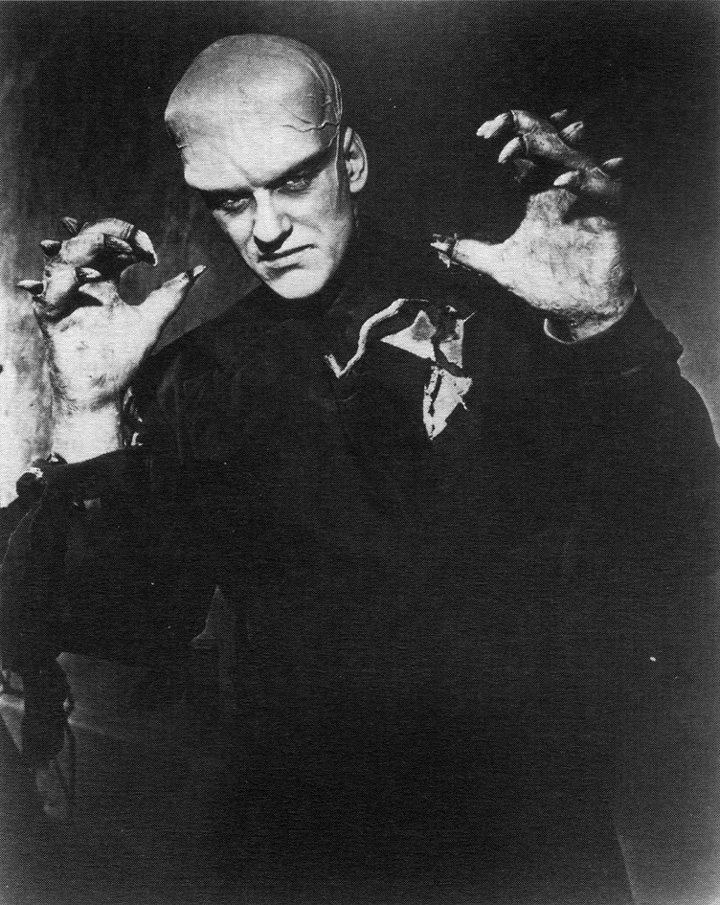
The Tabanga was created by the great Paul Blaisdell, bless his heart, the creator of such beasts as The She-Creature and the “It” from It Conquered the World.  Mr. Blaisdell’s creations are not always frightening, but they are memorable, and always entertaining. The Tabanga is no exception (see image at the top of this review). The terrible tree monster is endowed with a permanent scowl and unblinking eyes. It moves clumsily, and at a turtle’s pace. Whenever it bends, the foam rubber construction becomes painfully evident.

It’s not the laughable monster, nor the absurd plot that is the downfall of this movie, though. After all, foam rubber monsters and outlandish stories are what great B-movies are made of. What really kills this film is it’s dragging pace and tedious dialog. Not even a racy shower scene with Tina Carver can invigorate the segments not featuring the Tabanga. Linda Watkins, in the comedy relief role of Mrs. Mae Kilgore, only manages to make the slow scenes more grating. The novelty of Blaisdell’s Tabanga saves this film for me, but less hardcore fans are apt to be disenchanted.

Professional wrestler, Chester Hayes, not only plays Tabanga, the tree monster, but also the native, Maku (featured most prominently during the final sequences). Also, listen for Tina Carver’s screams while she is being abducted by the tree beast. They are some of the worst screams in all movie history. She sounds eerily similar to my cat hacking up a fur ball.

This movie effectively ended Milner Brothers Productions (Dan and Jack Milner) who produced The Phantom from 10,000 Leagues two years earlier.

Directed by Dan Milner.

Scene to watch for: The unstoppable Tabanga rises from the smoldering fire pit to exact revenge.

Line to listen for: “Will you stop being a doctor first and a woman second? Let your emotions rule you, not your intellect.”

Mark’s Rating! ! ½ out of 5.

Design a site like this with WordPress.com
Get started