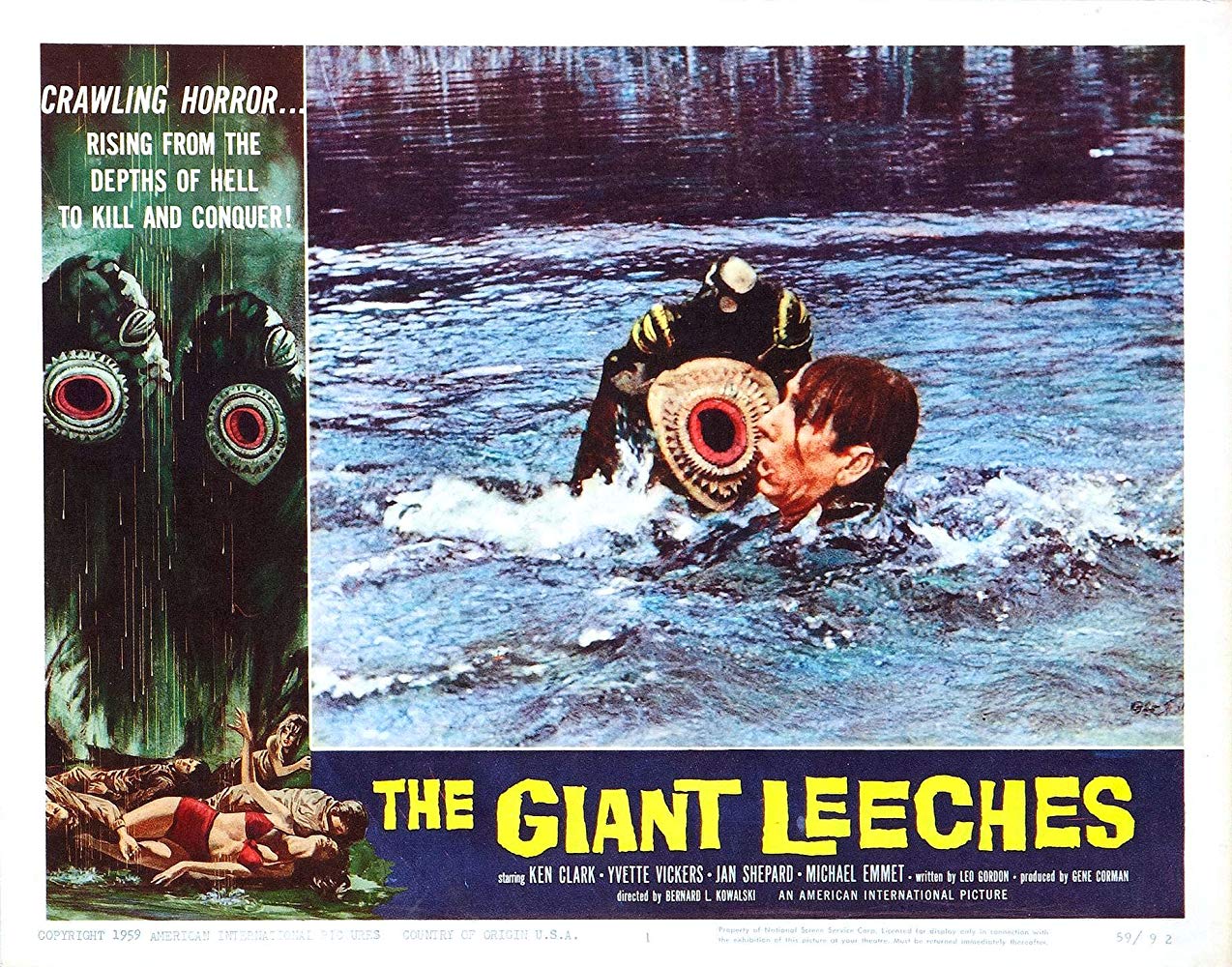
A bar owner forces his wife and her lover into a murky Southern swamp to be eaten by giant leeches. These over-sized bloodsucking monsters soon develop an appetite for human flesh. Sometimes scary, sometimes chilling, but always low-budget and slimy, this cult classic makes a fine choice for a late night scare/laugh. (1959, b&w)
Mark says:
Sometimes I wonder if the people who write descriptions for DVD cases have actually watched the movies they are describing. Anyway, this is a movie about giant leeches in a swamp.
You’ll recognize a lot of the same cast and crew from the movie Night of the Blood Beast. Low-budget kings Roger and Gene Corman produce the picture, and Bernard L. Kowalski directs it. You’ll also see Michael Emmet and Tyler McVey again as Cal Moulton and Doc Greyson, respectively. What this movie has, though, is what Night of the Blood Beast sorely lacks, Yvette Vickers (Attack of the 50 Ft Woman). I’ll watch anything with Yvette Vickers in it.
Yvette plays her part as the sexy, swamp tramp, Liz Walker, to the hilt. The scenes between her and Bruno VeSota (The Wasp Woman) as her unlikely husband, Dave, are by far the most enjoyable scenes of the picture. If the major story focused on them, this might have been a better movie.
Unfortunately, the hero of Giant Leeches is Steve Benton (Ken Clark). Steve and his girlfriend, Nan Greyson (Jan Shepard) are rather uninteresting people, and for some reason we spend a lot of time with these dullards. Tyler McVey as Doc Greyson is equally dull, and eats up a lot of screen time.
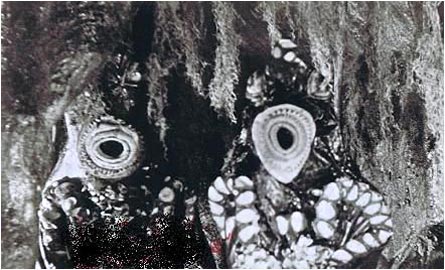
The creatures themselves are classic Corman monsters, typically described as men wearing garbage bags. Perhaps that description is a bit too harsh, but it’s not off by much. The more you see of the leeches, the worse they look. I imagine the hardest part for the actors was not laughing while the garbage bags sucked on them.
Attack of the Giant Leeches is a bad movie, but it is certainly good fun. The backwater swamp characters and dialog make for some amusing scenes. I found George Cisar as Lem Sawyer particularly entertaining. I was a little disappointed that he was killed off so quickly. In fact, a lot of the most interesting characters are killed off early in this picture. But I won’t list any more names; I don’t want to ruin the suspense for you.
This movie clocks in at just over an hour, and though it has its slow moments, the scenes with Yvette Vickers and Bruno VeSota make it worthwhile. You’ll want to watch it more for laughs than chills, though.
Scene to watch for: Dave Walker (Bruno VeSota) sops the sweat off his face as he watches his wife (Yvette Vickers) lotion her legs.
Line to listen for: “I wouldn’t touch that critter for all the money ever made! And if you seen it you wouldn’t neither!”
FYI: This movie is also known as Attack of the Blood Leeches, Demons of the Swamp (UK), She Demons of the Swamp, and The Giant Leeches.
They’re big. They’re bad. They scuttle along in caverns miles beneath the Earth’s crust – until a devastating earthquake opens up pathways to the surface. Now, inflamed by the smells of human flesh, these monsters of the genus Arachnida are here to stay! (1957, b&w)
Mark says:
Hoping to duplicate the success of Them!, Warner Brothers followed the same formula while producing The Black Scorpion. Unfortunately, the film falls short on many levels.
Richard Denning (Twice-Told Tales, Target Earth) plays the hero, Dr. Hank Scott. Denning’s portrayal is adequate, but I enjoy him more as a bad guy. Watch him in Creature from the Black Lagoon to see him in a more inspired role. Hank is a geologist sent to Mexico to study the effects of an enormous volcanic eruption/earthquake in a remote village.
Hank’s assistant is Dr. Ramos, played by Carlos Rivas (The Beast of Hollow Mountain). Dr. Ramos is a geologist on the Mexican side of the border. On their journey, Hank and Dr. Ramos realize they have more to worry about than just an active volcano.
When the pair of geologist reach their destination, they meet a wealthy landowner, Teresa Alvarez, played by B-movie regular Mara Corday (The Giant Claw, Tarantula). This is not my favorite role for Corday, but her acting comes in at about par for the genre. Miss Alvarez and Hank, not surprisingly, fall in love.
The Black Scorpion also features one of those annoying kids that so often mar these films. Mario Navarro plays Juanito, a boy who pulls several stupid stunts from which the adults have to rescue him. Mercifully, Juanito does not have scenes in the final segments of the film.
What strikes me as particularly silly about this film, is that it tries to make a mystery of something that is obviously implied in the title. We are given clues as to what may be causing the damage, but we know darn well that it’s a giant “black scorpion.”
But let me tell you why you should watch this movie: the fantastic stop-motion animation created by Willis H. O’Brien and Pete Peterson is immensely fun to watch. Of course, Willis O’Brien is primarily known for his fantastic work on King Kong.
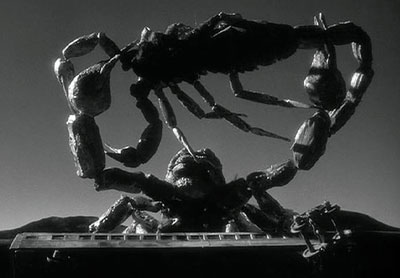
The scorpions are genuinely creepy in their movements. They are powerful beasts that sting and devour their prey in a most unseemly (yet entertaining) manner. There is an incredible sequence where the two geologists find themselves in a deep cavern. They discover not only a nest of giant scorpions, but a menagerie of other repulsive creatures as well. One of these monsters, a giant trap-door spider, is reportedly a leftover from the famous deleted spider scene in King Kong. All of the beasts are shuddersome, yet utterly fascinating to watch.
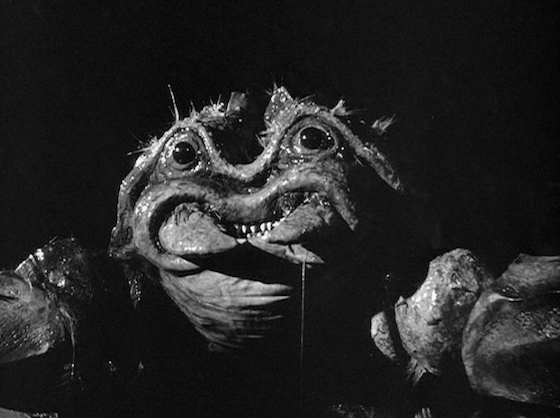
If I were to find fault with the scorpions, it would be in the use of a giant, drooling, scorpion head (see image at top of page). The drool is disgusting enough, but the head looks ridiculous and the same shot of the head is used ad nauseam throughout the film.
Another problem is that by the time the giant black scorpion was to attack Mexico City, the producers ran out of money. So instead of the superb stop-motion animation by O’Brien and Peterson, we are subjected to simple traveling matte shots of a featureless beast. It’s more like the city is under attack by the shadow of a giant scorpion. Thankfully, during the finale, the stop-motion process is preserved. It’s a real treat to watch the giant scorpion battle tanks and helicopters in a supreme and satisfying cornucopia of carnage.
The excellent stop-motion work makes The Black Scorpion worth your time, and though the acting and story are lacking, there is enough camp value here to keep you moderately entertained between scenes.
Directed by Edward Ludwig.
Scene to watch for: Hank, even after realizing the noise he heard was just a baby, keeps his gun pointed at the infant.
Line to listen for: “We interrupt this program to bring you a news bulletin: The express train from Monterrey has been derailed outside of Mexico City. Early reports indicate an appalling loss of life. There are eyewitness accounts which state that monster scorpions have swarmed around the wreckage, creating havoc!”
Like a lot of Gordon’s films, Earth vs The Spider has a promising start. Jack Flynn (Merritt Stone) is driving home to surprise his daughter with a locket for her birthday. Jack suddenly sees something stretched across the highway, and before he can stop, he collides with a cable (it’s supposed to be the strand of a giant spiderweb) which slashes through his face in a rather gruesome and bloody manner. But that’s where the excitement ends.
Mr. Flynn’s high school daughter, Carol (June Kenney; Attack of the Puppet People), is upset when her father does not return home. Amusingly, most people, even Carol’s mother, assume that Jack is on an all-night bender. Carol insists that her father didn’t get drunk “this time” and enlists her boyfriend, Mike Simpson (Gene Persson; Bloodlust!), to help search for him.
To make a long and not very interesting story short: Carol and Mike find her father’s truck crashed near a cave. Upon exploring the cave, they find some skeletons, a giant spiderweb, and a gargantuan spider-beast that almost devours them.
No adults will believe their story except for friendly science teacher, Mr. Kingman, played by Ed Kemmer (Giant from the Unknown). Mr. Kingman convinces Sheriff Cagle (Gene Roth; Tormented, Attack of the Giant Leeches) to investigate the situation. Wisely, they bring with them an exterminator and a tanker full of DDT. The sheriff loses a deputy, but they kill the spider (or they think they do) with the DDT.
Mr. Kingman thinks it would be a grand idea to keep the dead arachnid in the high school gymnasium while he tries to figure out what to do with it. Unfortunately, a band of jive-talkin’ rock n’ rollers awaken the monster during their rehearsal, and the beast goes on a rampage through town before heading back to its cave.
The remainder of the film involves tireless trips back and forth to and from the caverns. Any momentum built within the first half of the movie disintegrates during the final half. Camp value will only carry a film so far, and this movie peters out long before the finale.
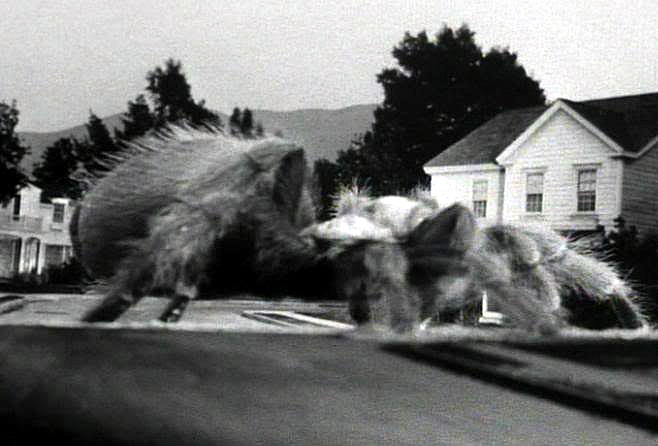
The special effects are the standard Bert I. Gordon variety, fun but atrocious. Mr. Gordon also had a single, mechanical spider leg constructed to use during scenes where he wanted the spider to appear in the same shot as the actors. The leg is obviously too thin to match the fat, furry legs of the real spider, and thus the effect is reduced to schlock cinema. Adding to the absurdity, the spider shrieks and roars in a manner that sounds suspiciously human.
Another facet of this film that strikes me as rather silly, is that most of the high school “kids” are conspicuously older than they should be. In fact, Mike and Carol’s friend, Joe, is played by Troy Patterson, who was 34 when the film was shot! It’s not too often you’ll see a teenager with 5 o’clock shadow.
Earth vs The Spider is filled with B-movie veterans. Besides the actors listed above: Hal Torey (Invisible Invaders) plays Mike’s father; Sally Fraser (War of the Colossal Beast, It Conquered the World) is Mrs. Helen Kingman, and Hank Patterson (Monster on the Campus, Beginning of the End) plays Hugo, the janitor. Hank Patterson is also a character in a movie this film tries to rip off, Tarantula.
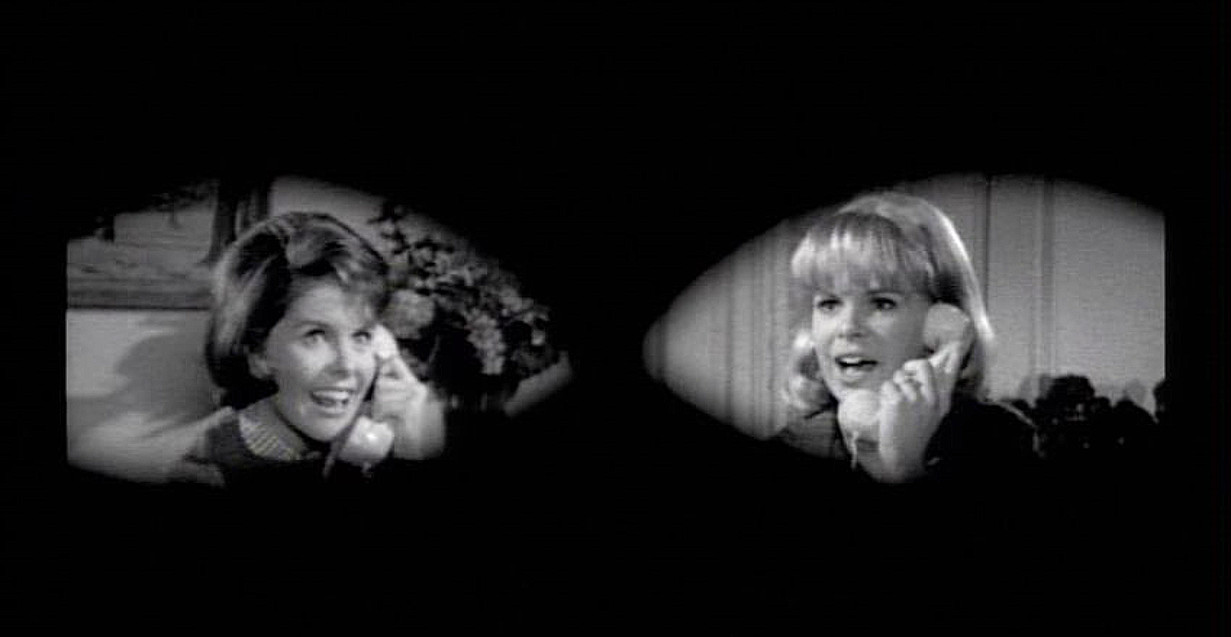
Adding insult to injury, Bert Gordon promotes two of his other movies in the course of the film. While talking to Carol on the phone, we clearly see a poster advertising The Amazing Colossal Man behind Mike. Mike then makes a reference to Attack of the Puppet People, which he says “sounds pretty wild.” There’s nothing quite like shameless self-promotion.
Earth vs The Spider is campy enough to be fun, but the story becomes tiresome early on. We lose interest in the characters so quickly that by the final rescue scene we simply do not care if they are devoured or not. The spider is scary, not because of its enormous size, but because all spiders are inherently frightening, at least in my book.
This movie was produced by Samuel Z. Arkoff, Bert I. Gordon, and James H. Nicholson.
Scene to watch for: Carol’s mother wants her to stop grieving her father and finish her homework. After all, it has been hours since Carol discovered her dad’s dead and shriveled body.
Line to listen for: “You know what we eggheads are like, sheriff. We want to know why this, how come that? What about the other? It’s a matter of scientific interest to find out what made that creature tick.”
Trivia: The title of the film, Earth vs the Spider, was used to ride the success of an earlier film, Earth vs the Flying Saucers. However, before release, another more successful film, The Fly, was raking it in at the box office. So in all of the promotional materials, the movie was advertised as The Spider, even though the main title on the film was never changed.
Earth becomes an unholy breeding ground for a swarm of giant man-eating locusts that devour everything and everyone in sight. Conventional weapons are no match for the colossal carnivores whose steel jaws crush soldiers like walnuts. Man is hopelessly outnumbered. As a last ditch effort, military strategists dispatch a B-52 bomber carrying an atomic bomb. Chicago will be turned into a nuclear wasteland unless a brilliant entomologist (Peter Graves) can come up with an alternative in time. (1957, b&w)
Mark says:
After the success of 1954’s Them! (giant ants), filmmakers were anxious to produce the next lucrative giant insect/animal picture. Over the course of years, several creatures were given the growth treatment with varying degrees of success, including: a praying mantis, a tarantula,a spider, scorpions, leeches, and crabs.
But only director/producer Bert I. Gordon (The Amazing Colossal Man, Empire of the Ants) could come up with insects as non-threatening as monster grasshoppers. That’s right, grasshoppers. It would not be until 1972’s Night of the Lepus, featuring gargantuan bunny rabbits, that a less menacing behemoth would hit the big screen.
Beginning of the End is your standard radioactive giant bug flick, kicked up a notch by the ultra-serious acting of Peter Graves (Killers from Space, It Conquered the World). Graves plays his role so straight that it gives the already ridiculous premise an added element of absurdity.
Peggie Castle (Bury Me Dead) stars as photographic journalist and love interest, Audrey Aimes. You’ll also recognize B-movie veterans Morris Ankrum (Earth vs the Flying Saucers, Kronos) as Gen. Hanson, and Thomas Browne Henry (The Brain from Planet Arous) in the role of Col. Tom Sturgeon.
Laughable special effects and dialog make Beginning of the End a camp favorite.
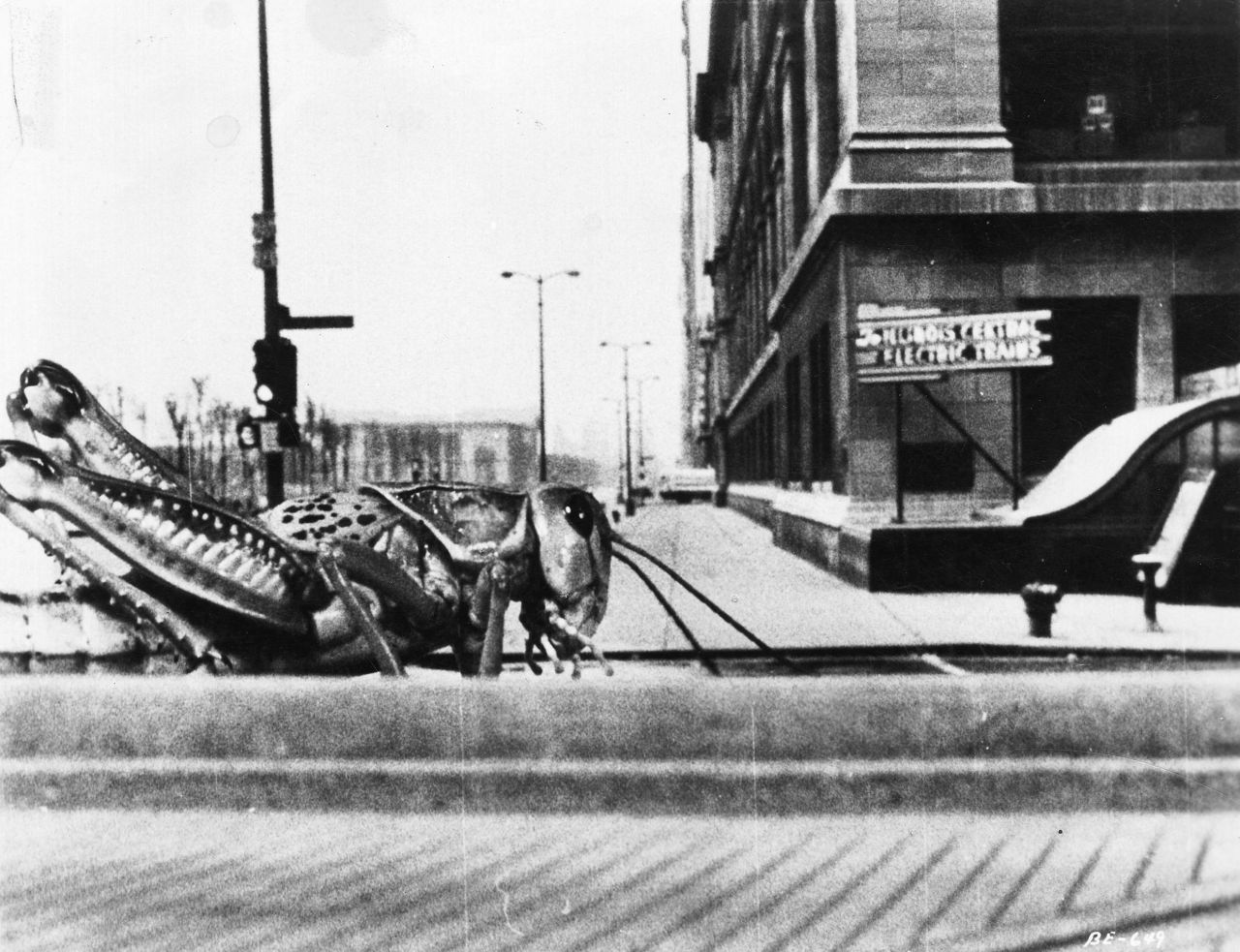
Scene to watch for: Grasshoppers sliding off postcards of Chicago buildings.
Line to listen for: “You can’t drop an atom bomb on Chicago!”
Special Note: The DVD commentary with film historian, Bruce Kimmel, and Bert I. Gordon’s wife (Flora) and daughter (Susan) is not that interesting. The most entertaining part of the commentary is listening to Mr. Kimmel croon over how hot Peggie Castle is.
When two teenagers make prank phone calls to strangers, they become the target for terror when they whisper, “I saw what you did” to a psychopath (John Ireland) who has just murdered his wife. I Saw What You Didfeatures a cavalcade of Castle-style shocks, plus a gloriously over-the-top performance by Joan Crawford as the killer’s desperately amorous neighbor. (1965, b&w)
Mark says:
I Saw What You Did is a cross between The Patty Duke Show and Hitchcock’s Psycho. Unfortunately, the emphasis rests primarily on the Patty Dukeaspect of the story. Of course, when William Castle (House on Haunted Hill, The Tingler) is listed as producer and director, you know to expect a fair amount of kitsch.
The premise of the story, based on the novel Out of the Dark, by Ursula Curtiss, sounds intriguing enough: Three girls (two teenagers and a little sister), spend the night alone in a secluded country home. To relieve their boredom they make crank phone calls. One of their routine calls consists of whispering, “I know what you did, and I know who you are,” to the person on the other end of the line.
Most people realize the call is a prank and hang up. However, Steve Marak (John Ireland, The House of Seven Corpses) has just murdered his wife, Judith (Joyce Meadows). To him, the call is deadly earnest. Through a series of events, Steve learns of the girls’ whereabouts and arrives at the house to kill off all witnesses.
With a story like that you would think it would be hard not to make this movie suspenseful, but William Castle somehow manages it. But maybe I’m being too harsh.
Sarah Lane and Andi Garrett play the two teenage girls, Kit Austin and Libby Mannering, respectively. Kit and Libby are what I suppose people thought of as typical teenage girls at the time. They are giggly, mischievous, boy-crazy, and a bit daft. And though we are never given evidence of this in the picture, I have a feeling that a hot dog would indeed make them lose control. That’s another Patty Duke reference if you’re of a younger ilk.
Libby has a little sister, Tess, played by Sharyl Locke. Tess is one of those annoying little kids that appear often in films of this era and genre (for more examples watch for the little brother in The Blob, or that unpleasant boy in The Black Scorpion.) Tess, like the two older girls, has a naïveté about her that borders on a mental impairment.
John Ireland plays the murderer, Steve Marak, in a determined but colorless fashion. In an obvious rip-off of Hitchcock’s Psycho, Marak stabs his wife to death in the shower. We are even treated to shots of the water nozzle and chocolate syrup (blood) spiraling down the drain. But in Castle’s version of the shower scene, it is Marak in the shower, and he pulls his wife, fully clothed, in with him to finish the deed. He then shoves her through the glass shower door and leaves her splayed on the bathroom tile. I have to admit, when first viewing this film I did not expect such a violent screen death.
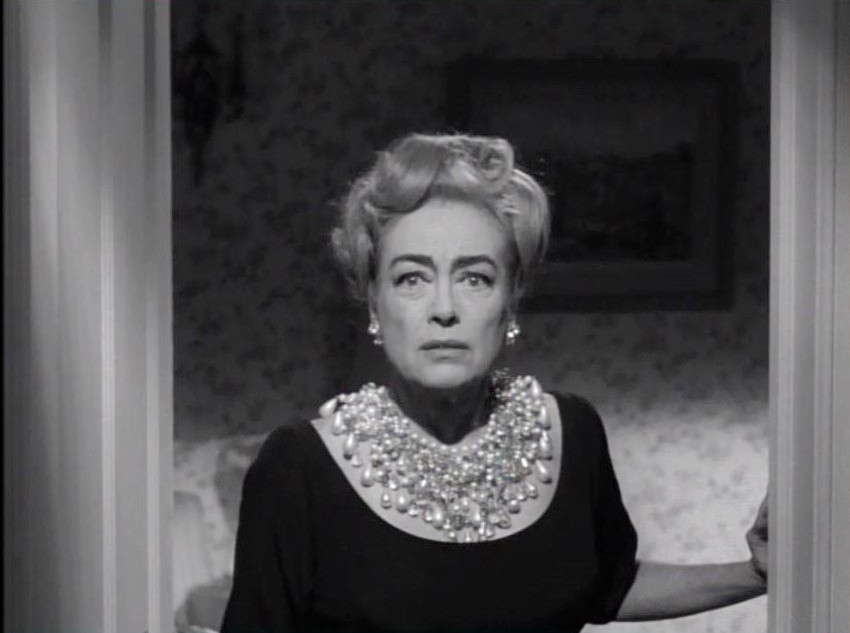
More frightening than John Ireland’s character, though, is Joan Crawford (What Ever Happened to Baby Jane?) in the role of Amy Nelson (that’s Crawford pictured above). Just look at that face. Look at those eyebrows. Look at that hairdo. Look at that NECKLACE! Everything about her promotes terror. Even a killer like Marak seems a little afraid of her.
Amy is Marak’s neighbor who has obviously harbored feelings for him for quite some time. She believes Marak’s wife has run off and so she takes this opportunity to make her own claim on him. When she discovers what actually happened, she tries to blackmail Marak into marrying her, which doesn’t turn out well. Crawford gets star billing, but she has very few actual scenes. However, her campy performance adds tremendously to the entertainment value of the film, and I am thankful her role was included.
One of my biggest complaints about this production is the incredibly annoying and inappropriate soundtrack. The music was composed by Van Alexander, and always puts me in the mind of Baby Elephant Walk. It’s fun and perky, but does nothing to build suspense or add to the secluded atmosphere. At some points the music takes a slightly darker tone, but it’s always based on that same sappy theme. It’s hard to imagine a worse soundtrack for a thriller.
I do give I Saw What You Did some credit for attempting to create an isolated and spooky setting. A house secluded in the country can seem a little eerie. The evening sequence almost captures a menacing quality, but the friendly animals (a goat and a horse) seem to negate the mood somewhat.
Though I Saw What You Did really isn’t that scary, it does have some camp value and a few shocking moments. It’s definitely not one of my favorite Castle films and seems to be a bit longer than necessary. Look for Leif Erickson (Invaders from Mars) in the role of the father, Dave Mannering.
I Saw What You Did was remade as a TV movie in 1988.
Scene to watch for: Amy (Joan Crawford) strains to finish her kiss with Steve (John Ireland) even after he has just fatally stabbed her. Talk about looking for love in all the wrong places.
Line to listen for: “You want to crack a whip? Get yourself a dog.”
Trivia: During its original release, some theaters provided seat belts so you wouldn’t be “shocked out of your seat.”
Dr. Markway is an anthropologist with a special interest in psychic phenomena who wants to try a true exercise in terror. Intrigued by the legend of Hill House, he invites two women, psychic researchers, to join him in his adventure. Mrs. Sannerson, who has inherited the old mansion, is suspicious of Dr. Markway’s intentions and insists that her young nephew Luke go along with the group. Luke is a skeptic about the supernatural, until he enters Dr. Markway’s eerie world. (1963, b&w)
Mark says:
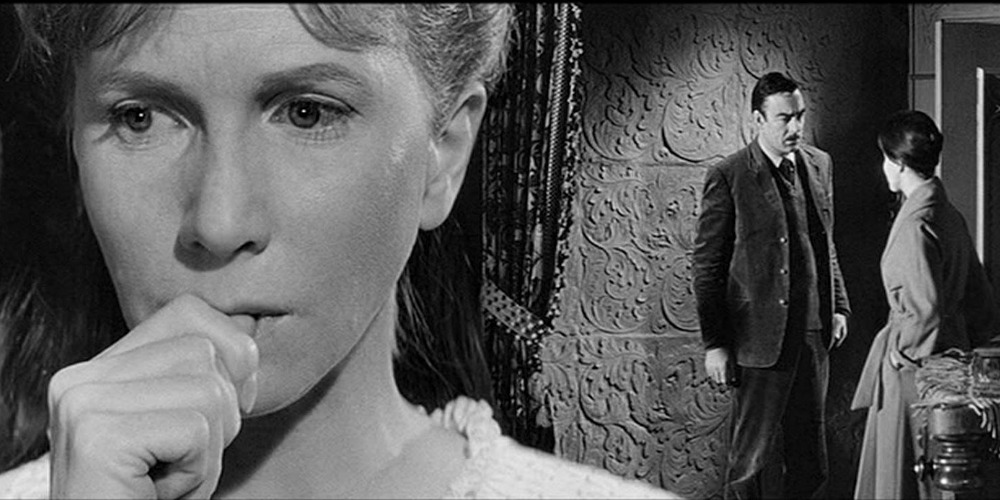
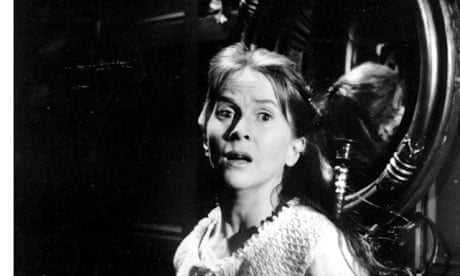
The major flaw with the description posted above is that it neglects to mention the character this film is centered around, the nervous Eleanor Lance, played exquisitely by Julie Harris. It also features the talents of Claire Bloom (The Illustrated Man) as Theo (the psychic with lesbian undertones), Russ Tamblyn as Luke Sanderson (the young skeptic), and Richard Johnson as Dr. Markway. This film is based on Shirley Jackson’s novel, The Haunting of Hill House.
As a testament to The Haunting, I will state up front that I’ve only watched it twice. Once when I first purchased it on video cassette years ago, and then again tonight. How is this a testament, you ask? It’s a testament in the sense that this movie freaked me out so much during my first viewing that I have only tonight gone back for seconds.
The Haunting competently combines the supernatural with psychological terror. We are allowed (or, more accurately, trapped) inside Eleanor’s head and feel her sense of isolation, loneliness, fear, and unreality. This is accomplished not only with her voice overs, but with Robert Wise’s (The Day the Earth Stood Still) fine direction. It would be hard to overestimate the effectiveness of the camera work in this picture.
An amazing aspect of The Haunting is that it is frightening without ever showing us a ghost,a severed hand, or even a drop of blood. In fact, sometimes we are left wondering if the spirits are only in Eleanor’s mind. You can’t deny a certain existential feel to the movie.
If I had to find fault with this film, it would be in the hot/cold relationship between the two female leads. Theo and Eleanor are practically in love with one another one moment, and then verbally abusing each other the next. This cycle runs throughout the movie’s entirety. I suppose it helps add to the sense of uncertainty, but it can get annoying.
Though I wasn’t as unsettled during my second viewing of The Haunting as I was the first, I still declare it to be one of the scariest ghost movies around. All points given are for true artistic merit and genuine chills. I recommend watching it alone and in the dark.
Scene to watch for: Eleanor, already at the point of nervous breakdown, realizes the hand that has been clutching hers so tightly isn’t the hand of her roommate.
Line to listen for: “The dead are not quiet in Hill House.”
We have met the enemies and they are our children. Well, perhaps not our children, and that’s the problem: they are the offspring of aliens who secretly impregnated human women!
That’s the riveting premise of Village of the Damned, a science-fiction classic rife with paranoia and set in England’s tiny Midwich. There, the glow-eyed humanoids develop at an alarming rate and use astonishing powers of mind to assert their supremacy. Woe to parents or anyone who defies them. Yet one intrepid soul (George Sanders) does. (1960, b&w)
Mark says:
This is another marvelous film saddled with an unfortunate title. It is based on the John Wyndham novel, Midwich Cuckoos. Cuckoos being birds that lay their eggs in foreign nests to be raised by foreign parents.
What I admire so much about Village of the Damned is how understated it is. The events unfold in a tiny town populated with predominantly common people. There is something about ordinary people dealing with extraordinary circumstances that naturally draws our interest.
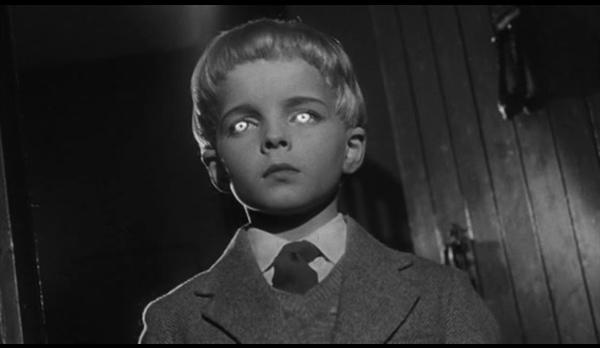
The children, led by Martin Stephens (The Innocents, The Witches), are effectively cool and creepy. The simple effect of their glowing eyes is supremely chilling, as well as efficient. As a kid you both fear and envy these children with their ruthless control over the adult world.
The protagonist of this movie is Prof. Gordon Zellaby, played wonderfully by George Sanders (The Picture of Dorian Gray). He is not only a scientist assigned to the matter, but the “father” of the lead child. Barbara Shelley (Dracula: Prince of Darkness, Quartermass and the Pit) plays his much younger wife, Anthea, who struggles between a maternal love and justified fear of her son. You may also recognize Michael Gwynn (Revenge of Frankenstein, Scars of Dracula) as Prof. Zellaby’s brother-in-law, Maj. Alan Bernard.
Besides a strong cast, who play their parts without a hint of campiness, Village of the Damned also possesses powerful direction from Wolf Rilla. The scenes are crisp and subtle. There is very little onscreen violence, but suspense and suggestion are used competently. Even without a lot of action, we never lose interest in the story. It is more than a little refreshing to watch a film of this genre that holds our attention by the use of ideas rather than overblown effects and violence.
Village of the Damned gets a hearty recommendation from me.
Scene to watch for: Always test the temperature of the milk on your wrist first before feeding it to your alien child.
Line to listen for: “You have to be taught to leave us alone.”
Note: If you happen to come across the Warner Bros. DVD featuring Village of the Damned combined with the adequate but inferior sequel, Children of the Damned, buy it. Not only will you get a good price for two films, but film historian Steve Haberman’s commentary on Village of the Damned is full of interesting facts and tidbits.
It sits there, shrouded in mist and mystery, a nesting place for living evil and terror from the dead. It’s Hell House. Roddy McDowall heads the cast of this exciting chiller about four psychic investigators and the dark, brooding mansion they themselves call “the Mt. Everest of haunted houses.” It’s already destroyed one team of researchers. Now this brave quartet ventures in for another try at unraveling its secret. (1973, color)
Mark says:
The Legend of Hell House is another film adapted from a novel by Richard Matheson (Duel, The Incredible Shrinking Man). Matheson wrote the screenplay himself, though many of the explicit scenes from his novel (Hell House) had to be toned down to receive its PG rating.
Matheson had high hopes in regards to assembling a cast:
At one time I had in my mind a dream cast of Richard Burton and his wife Elizabeth Taylor to play the two mediums, Rod Ststeiger and his wife Claire Bloom to play the professor and his wife. Just after they made The Legend of Hell House people began making the really classy, A-picture-type horror films, starting with The Exorcist, so if I had held onto Hell House a few more years, it might have gotten that kind of treatment, too.
Though Matheson did not receive his “dream cast,” the players in Hell House are quite competent. Clive Revill (The Headless Ghost) plays Mr. Lionel Barrett, a physicists and paranormal investigator hired to establish the facts regarding life after death. Barrett believes in paranormal phenomenon, but postulates that it can be explained scientifically. Specifically, he believes all hauntings can be reduced to the effects of electro-magnetic radiation. He even develops a machine to neutralize such radiation.
Gayle Hunnicutt (Eye of the Cat) plays Mr. Barrett’s wife, Ann. Ann doesn’t seem to be much help to her husband, but it is established early on that she attends all of his investigations as a type of moral supporter. Hunnicutt does an excellent job of playing not only a naïve housewife, but a sexually charged vixen when possessed by an entity within the house.
The two actors that really make this movie click for me, though, are Roddy McDowall (Planet of the Apes, Fright Night) as Benjamin Fischer and Pamela Franklin (Necromancy, The Innocents) as Florence Tanner. Matheson did not think either actor was quite right for their roles (he stated Franklin “seemed too young”), but short of Richard Burton and Elizabeth Taylor, I think they give fine performances.
Mr. Fischer is a “physical medium,” which means the spiritual realm is able to manifest itself physically through him. Fischer is the only survivor from the previous investigation twenty years earlier, when he was only 15 years old. Accordingly, Fischer comes off as a bit of a coward and we eventually learn that he has “shut himself off” from the forces of the house. Perhaps wisely, he is only willing to stick out the week, collect his money and run. Fortunately, by the film’s conclusion, Mr. Fischer attains some gumption and ultimately unlocks the primary secret of the house.
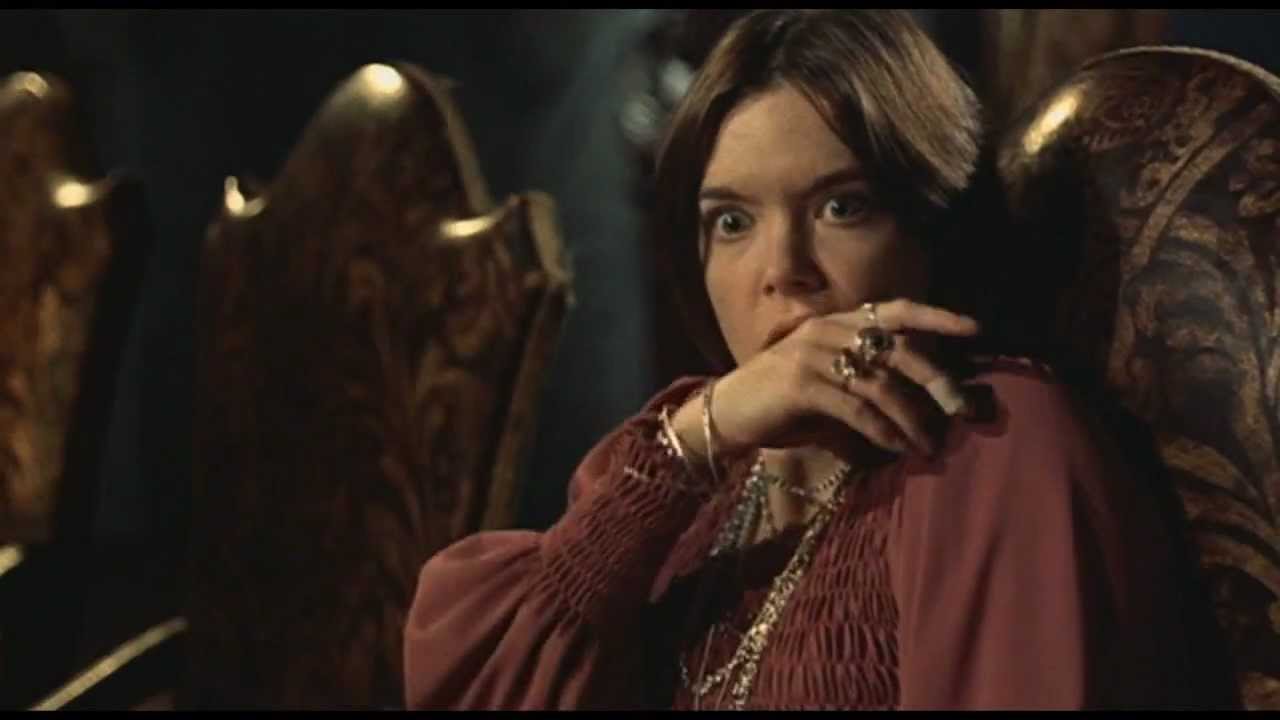
Florence Tanner is a young “mental medium,” which gives spirits the ability to speak to and through her. Pamela Franklin plays the role exquisitely as a virginal innocent who is primarily concerned with helping the “residents” of Hell House achieve peace. Florence is treated quite shabbily by the house. She is slashed, attacked by a possessed cat, is possessed herself, and even raped by an evil entity. One of the most chilling scenes of the film occurs when the other investigators discover Miss Tanner after the rape. Tanner turns to face them, and her girlish innocence is replaced by an utterly wicked smile and giggle. It’s truly an unsettling transformation.
The theme of The Legend of Hell House lends itself to comparison with the 1963 classic, The Haunting. Both films deal with a group of investigators researching a notorious haunted house. The Haunting, however, focuses primarily on one character, Eleanor Lance, played by Julie Harris. Hell House, on the other hand, is more of an ensemble. The tension in Hell House is not only derived from the spiritual shenanigans, but from the battling egos and theories of the investigators.
Ultimately, I find The Haunting to be the superior film, not only in story, but in cinematography as well. The Legend of Hell House uses reflections and a distorted fish-eyed lens to enhance the uneasy and unreal flavor of the story. Unfortunately, some of the camera work borders on cheesiness. For example, a scene involving a distressed Pamela Franklin begins spinning faster and faster in a fashion reminiscent of the old Batman TV series.
However, the most crucial flaw of the movie is its climax. I am not going to give away anything here, but I will say that the final showdown is so preposterous that it is dangerously close to being silly.
Flaws aside, this is a wonderfully atmospheric movie that uses very little gore or special effects to achieve its eeriness. The acting is strong and the story is intelligently told. Look for a brief cameo by Michael Gough (Konga, Horrors of the Black Museum) as Emeric Belasco, the deceased, nefarious owner of the house who participated in “drug addiction, alcoholism, sadism, bestiality, mutilation, murder, vampirism, necrophilia, cannibalism, not to mention a gamut of sexual goodies,” which made the house so evil.
Directed by John Hough (Twins of Evil).
Scene to watch for: When Mr. Fischer decides to finally “open up” to the forces of the house, he suffers contortions that are almost comical. Strangely, I experienced the same contortions when the mystery of the house was revealed.
Line to listen for: “What’s to tell? The house tried to kill me. It almost succeeded.”
Trivia: The Legend of Hell House was the first and last film produced by James H. Nicholson (The Abominable Dr. Phibes, The Pit and the Pendulum) after he left AIP. He died of a brain tumor shortly after production.
Starring David Naughton, Jenny Agutter and Griffin Dunne, this classic horror/comedy tells the beastly tale of two American youths whose European adventure turns to terror after they are attacked by a werewolf. One of the travelers is killed, but the other’s fate is worse than death as every full moon now seems to “bring out the beast in him.” (1981, color)
Mark says:
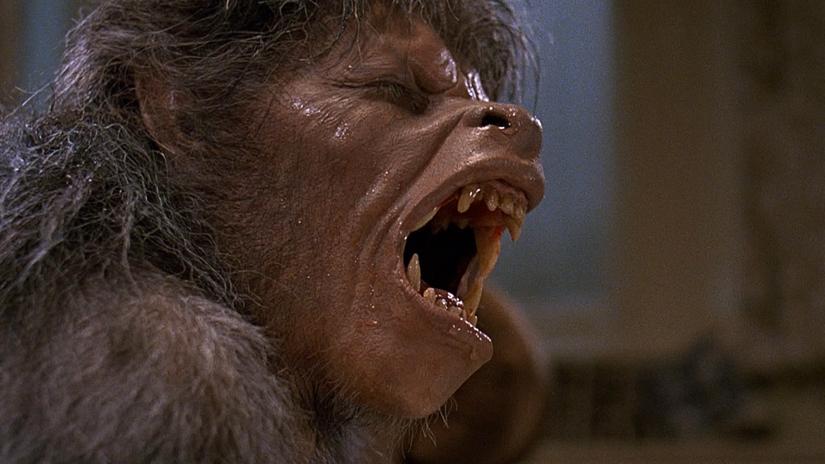
1981 was a great year for me. Not only did I graduate from high school, but two of my favorite werewolf flicks were released. One was The Howling and the other was An American Werewolf in London, which I have the pleasure of reviewing now.
An American Werewolf in London has a lot going for it: a simple but intriguing story, a strong script and good direction, characters we care about, and perhaps most of all, groundbreaking special effects engineered by Rick Baker. The film is both written and directed by John Landis (Twilight Zone: The Movie, Animal House).
As the video description states, An American Werewolf in London is a horror/comedy. Usually I’m not a big fan of this genre, however, in American Werewolf, the humor is such a natural extension of the story that it is completely non-intrusive. It does not distract the viewer, but rather pulls him/her deeper into the tale. The banter between the two American friends, David and Jack (David Naughton and Griffin Dunne, respectively), is a good example. Their witty back and forth gives their characters a likable quality. When something does happen to them, even though we know it must, we are still shocked. It also scares the holy frijoles out of us. The humor actually adds contrast to the terror, making both elements more stark.
The nightmare sequences are not only disturbing, but they keep us off balance. At first, it is difficult to decipher what is real and what is delusion. When Jack returns from the dead to warn David that he will become a werewolf at the next full moon, and that he must kill himself before he kills others, we are just as uncertain of Jack’s reality as David is. We aren’t allowed to get our footing, which keeps us in a constant state of unease.
Jenny Agutter as Nurse Alex Price does an admirable job as David’s love interest. Their relationship is, for the most part, believable. There is a scene when David is trying to get himself arrested where their chemistry seems a bit strained, though. David, in an attempt to get put behind bars before he kills again, yells out derogatory slogans like, “Queen Elizabeth is a man!” and “Shakespeare’s French!” During this fiasco, Nurse Alex tries to calm him, and suddenly David is declaring his love for her. I think this is supposed to be a touching, maybe even romantic, moment. However, it feels forced and awkward, and I always find myself cringing just a little bit.
Transformation scenes are always the money shots in werewolf flicks, and An American Werewolf in London features one of the best transformations of all time. Not only does the transformation look real, it looks painful. Make-up Artist, Rick Baker, won the first Academy Award for special effects for his work in this movie. Let me quote an enthusiastic Alan Jones from his book, The Rough Guide to Horror Movies, regarding Baker’s efforts:
But it’s mainly for Rick Baker’s incredibly realistic creation of a metamorphosis from man to beast that Landis’s lycanthropic landmark will always be remembered. David’s bones and muscles bend and reform, his flesh moves, his backbone ripples, his face distorts as his jaw extends and his hair sprouts everywhere. It’s absolutely astonishing.
And I absolutely agree.
The film’s finale in Piccadilly’s Circus is a stunning spectacle that you’ll need to experience for yourself. Though the film’s conclusion seems abrupt, it fits the shock motif of the rest of the movie. We are left bewildered and dismayed as The Marcels upbeat version of “Blue Moon” is cued and the credits roll. It’s like a cold glass of water suddenly thrown into our collective faces.
An American Werewolf in London is an amazing horror picture sure to please any lycanthrope fan. What’s more: it’s scary.
Scene to watch for: David explains to Alex the plot of The Wolf Man, starring Lon Chaney Jr. (Alex, being British, thinks he is referring to “the one with Oliver Reed,” but David corrects her saying “no, the old one.”)
Line to listen for: “Have you tried talking to a corpse? It’s boring.”
Trivia: Each song in American Werewolf features the word “moon” in its title. John Landis also wanted to include Bob Dylan’s version of “Blue Moon,” and Cat Steven’s “Moonshadow,” but both artists declined the offer.
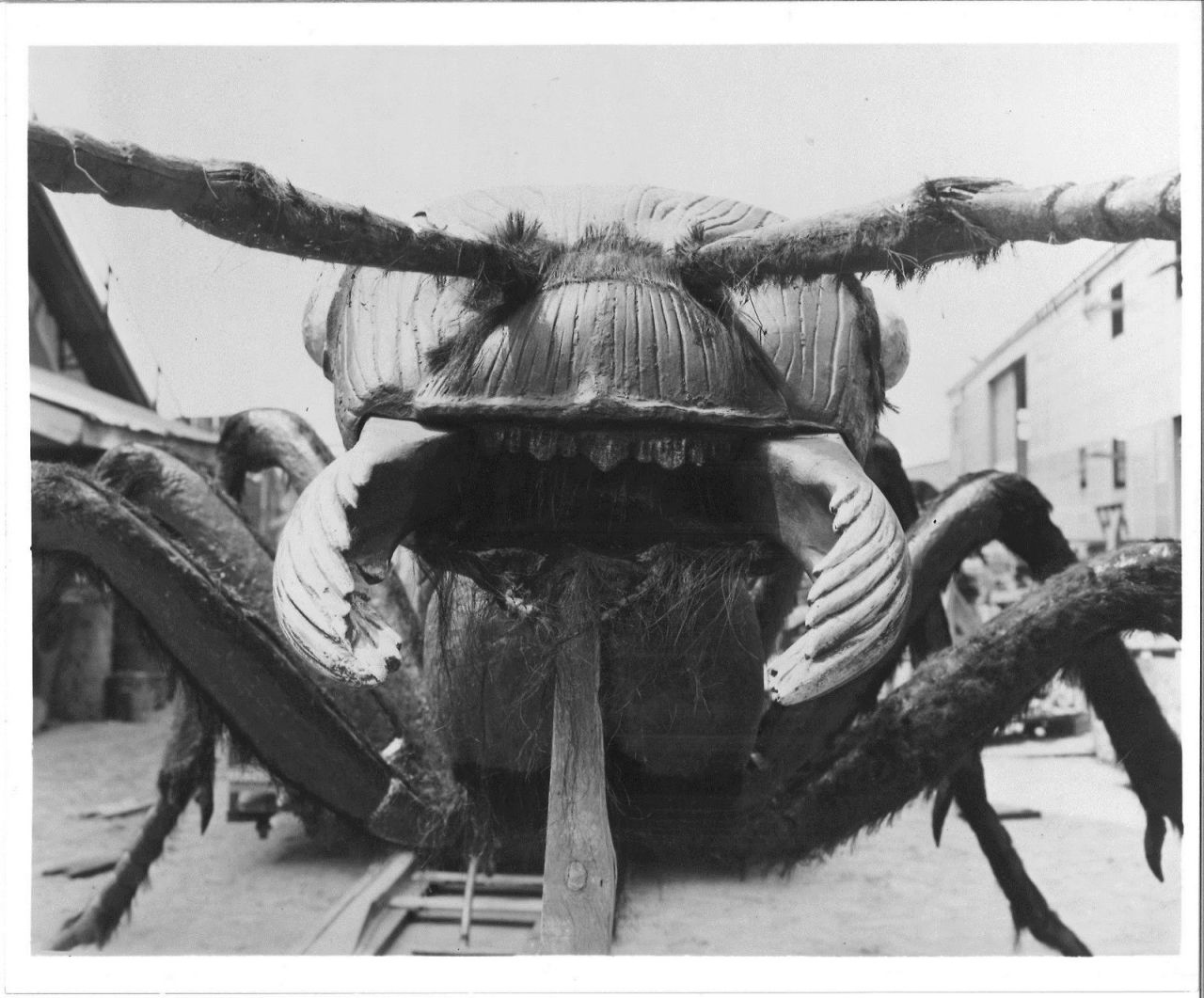
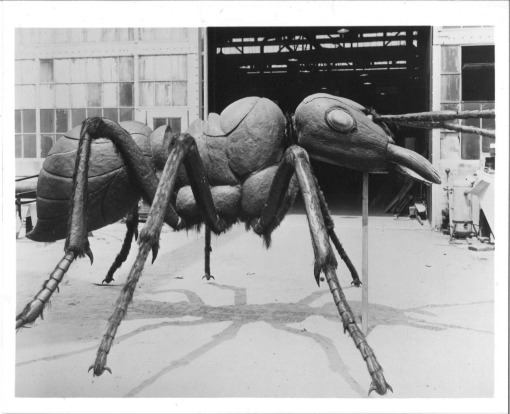
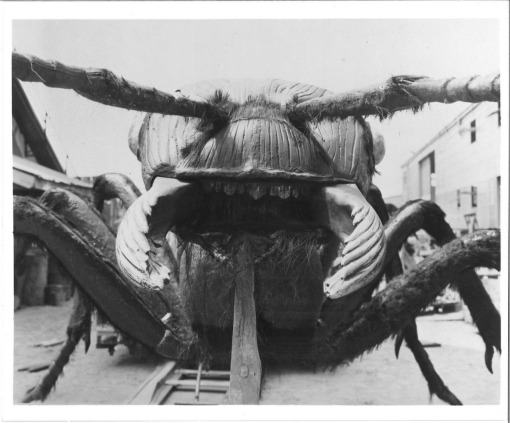
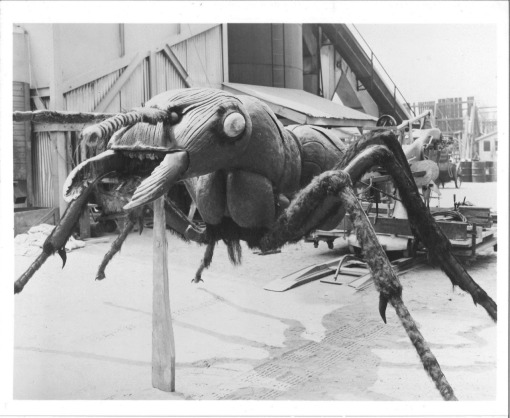
Here’s a radioactive treat for you: the making of one of the ants for the classic sci-fi film, THEM! (1954) Read my review here. Click picture to see full pictorial.
When Helga Hammond (Heather Angel) hears of a legend that an unholy alliance was formed between the devil and her family, whereby a male member of the family is to be sacrificed every few years, she discounts it as nonsense. But a series of attacks at the family estate by a horrific beast – part man and part wolf – seems to give credibility to the legend. When Helga’s brother Olvier (John Howard) is attacked, it appears that the legend is true. As Scotland Yard Inspector Robert Curtis (James Ellison) investigates the link between the werewolf and the family, he uncovers a shocking secret! (1942, b&w)
Mark says:
The Undying Monster was produced to capitalize on the success of The Wolf Man, released a year earlier, and at first we think we’re watching a film that may rival the Universal classic.
Immediately we are drawn in by the atmospheric cinematography of Lucien Ballard and the superb direction of John Brahm (Hangover Square, The Lodger). As a clock strikes midnight, we are given mysterious views of Hammond Hall with each gong. We move from a coat of arms, to a woman’s limp (lifeless?) hand, to a Great Dane, to a suit of armor, and so on. Already, we are treated to a certain amount of apprehension and curiosity.
The film’s heroine is Heather Angel (1932’s The Hound of the Baskervilles) as Helga Hammond. It was her hand that was dangling lifelessly during the introduction, but we discover she was only sleeping in front of the fire. Helga is a strong, independent woman who scoffs at superstition and has no qualms about handling a gun or running into the night when she believes her brother, Oliver Hammond (John Howard, The Invisible Woman) may be in trouble.
Less courageous is Helga’s butler, Walton (Halliwell Hobbes, Dracula’s Daughter). Walton and his wife, played by Eily Malyon, have watched over the Hammond estate for generations, and seem privy to information not shared with Helga or her brother. We get our first clue that The Undying Monster might not maintain its strong start when Walton quotes the line, “When the stars are bright on a frosty night, beware thy bane on the rocky lane,” obviously an attempt to recreate the famous ditty from The Wolf Man: “Even a man who is pure in heart and says his prayers by night, may become a wolf when the wolfbane blooms and the autumn moon is bright.” Walton’s verse is decidedly lame in comparison.
Still, we have high hopes as we hear an uncanny howl and a woman’s scream. We are suddenly transported to the point of view of the beast as he savagely attacks a young woman. The camera is jostled violently to mimic the brutality of the monster. Helga springs into action, gun in hand, to fend off the creature and rescue anyone in danger. Helga discovers her brother unconscious and badly beaten on the rocks, and the woman, Kate O’Malley (Virginia Traxler), mauled and in a coma. Kate eventually dies of her wounds, never regaining consciousness.
And here, dear reader, is where The Undying Monster takes a nosedive. Instead of concentrating on the supernatural element of the story, we shift to a detective murder mystery, with amble amounts of distracting comedic banter.
First we meet Scotland Yard investigator, Robert Curtis, played by James Ellison (I Walked with a Zombie). Curtis is a fellow who trusts no one and practically accuses everyone of foul play before the film’s conclusion. For this reason he comes off as rather obnoxious, and unfortunately, distinctly American.
However, as disagreeable as Curtis is, his assistant, Cornelia ‘Christy’ Christopher (Heather Thatcher) is immensely more irksome. Christy is one of those characters so often thrown into films of this era to provide comedy relief. Long time readers know my pet peeve regarding such mood-breaking personalities. I don’t mind a certain amount of humor thrown into a horror flick, but this woman is relentless in her mugging and one liners.
The Undying Monster is a mere 63 minutes long, but far too much time is devoted to Curtis’ forensics rather than the more interesting legend of the Hammond family. Surely the intrigue of a family curse involving an ancestor selling his soul to the devil should take precedence over a detective comparing cloth samples.
The film does redeem itself somewhat toward the end when we actually get a view of the werewolf. Though not as elaborate as Lon Chaney, Jr’s make-up, the Hammond Beast is adequately impressive. Unfortunately, these final scenes are a small payoff for what seems like an hour of wasted time.
The sets are surprisingly elaborate for a B picture. The interior of Hammond Hall is effectively huge and eerie. Additionally, the exterior scenes, though obviously a sound stage, are wonderfully ominous. The Undying Monster has a great look and feel to it.
Overall, The Undying Monster gets high marks from me for the moody cinematography and John Brahm’s competent direction. If only the script was better, this could have been a real classic.
The Undying Monster was based on a novel by Jessie Douglas Kerruish.
Scene to watch for: When the werewolf is finally killed, he is revealed to be . . .
Line to listen for: “Sometimes dogs are smarter than folks.”
Special thanks: to Lance of Kindertrauma for alerting me to this forgotten gem.
Here at Exclamation Mark’s Monster Movie Reviews, I like to share articles and pictorials that may be of interest to monster movie fans.The following article was originally published in Films and Filming (London), November 1957 and then reprinted in Castle of Frankenstein #14, 1969. A very special thanks is due to regular reader, Paul Bollenbacher, for sending me this article in its entirety.
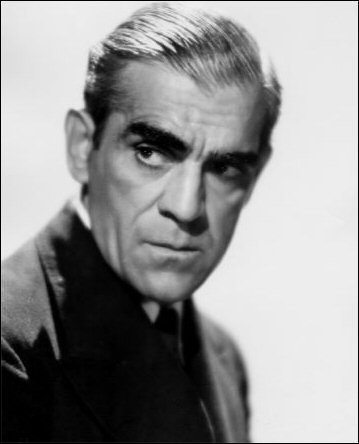
My Life as a Monster by Boris Karloff
I dislike the word “horror” yet it is a word that has been tagged to me all my life. It is a misnomer…for it means revulsion. The films I have made were made for entertainment, maybe with the object of making the audience’s hair stand on end, but never to revolt people. Perhaps terror would be a much better word to describe these films, but alas, it is too late now to change the adjective. My films even prompted the British Censor to introduce a certificate in the early 30’s known as H…for horror.
Early in 1931 when the first Frankenstein film was released the Universal publicity department coined the phrase “A Horror Picture” and from that day on the “horror film” was here to stay. This genre of film entertainment obviously fulfills a desire in people to experience something, which is beyond the range of everyday human emotion. This conclusion can be drawn from two facts.
First, from the tremendous success financially and otherwise of the early Frankenstein films and subsequent pictures of a similar type. Secondly, because of an incident on the set of Stranglehold, a British “horror” film which I have just finished making at Walton Studios. We were about to shoot a sequence in which a man is fogged. Suddenly the set was crowded by studio workmen and office girls all eager to have a look! There is a violent streak in all of us: and if it can be exploded in the cinema instead of in some antisocial manner in real life, so much the better.
Perhaps the best possible audience for a “horror” film is a child audience. The vivid imagination with which a child is gifted is far more receptive to the ingredients in these pictures than the adult imagination, which merely finds them artificial. Because they have vivid imaginations we must not underestimate children…they know far more than we think they do.
When I played Frankenstein’s Monster I received sack loads of fan mail…mostly from young girls. These children had seen right through the make-up and had been deeply moved by sympathy for the poor brute.
Children choose what they want to see in an entertainment. This was brought home to me during the record run of Barrie’s Peter Pan at the Imperial Theatre in New York. I played Captain Hook and, being interested in the children’s reaction to the play, I invited a horde of them to come along to the theatre. Peter Pan, as everybody knows, is a mixture of romanticism and adventure. The somewhat frightening exploits of Captain Hook are offset by the whimsy of Tinker Bell. The frightening element would possibly, one would think, stay in a child’s mind far longer than the fairy element. After the final curtain I took them backstage and introduced them to the cast. Almost all the children would first want to meet Wendy and Tinker Bell and then they would want to put on the Captain’s hook. Their first reaction when they looked at themselves in the mirror was a grunt and scowl and make the same type of lurching gestures, as does Frankenstein’s monster.
The fascination of the “horror” film is perhaps because it is make-believe. Most people like to pretend that there is something just behind the door. It transports the audience to another world. A world of fantasy and of imagination. A world inhabited by the characters of Hans Andersen and the Brothers Grimm. The “horror” film is concocted more or less from the folk tales of every country. When I am asked if these films are harmful to children, my answer is always the same: Do Grimm’s fairy tales do any harm to children? I have never heard of fairy tale books being used in evidence in a juvenile delinquency case!
Naturally, good taste plays a very important part in the telling of a “horror” story on film. Some have taste, others regrettably have not. As there are no rules laid down to give an indication of good taste it is up to the film’s makers.
You are walking a very narrow tight rope when you make such a film. It is building the illusion of the impossible and giving it the semblance of reality that is of prime importance. The moment the film becomes stupid the audience will laugh and the illusion is lost…never to be regained. The story must be intelligent and coherent as well as being unusual and bizarre…in fact just like a fairy tale or a good folk story. The “horror” has to be for the sake of the story and not as a few recent films had done, have a story outline just for the sake of injecting as many shocks as possible.
The central character is most important in a “horror” picture because he is more complex.
You must understand his point of view although you know he is mistaken. You must have sympathy for him although you know his is terribly wrong. An example of a good central character of this type was Columbia’s Mad Doctor in the famous series. Although you were pleased to see him destroyed you were sorry that it had happened.
The special technique of “horror” filmmaking is to stimulate the imagination. This is usually done by showing bits and pieces, which gradually build up a picture in people’s imagination. For instance, in the Frankenstein films one saw the doctor with fuming liquids, bubbling test tubes, lights flashing and electrical circuits buzzing. These various images cut together heightened the tension. At the correct moment the monster would appear and (I hope) the audience would jump. It is important in any visual entertainment to allow the audience to use its imagination–never underline the action. If sympathy is wanted for the character, he himself must reject sympathy.
Although I am devoted to the part of the Monster in the Frankenstein films (if I lived to be a thousand I would always be associated with them) I pulled out after making the third in the series. After the first three I could see that the possibilities were exhausted for both Dr. Frankenstein and his Monster. In fact, the poor brute was becoming a comic prop for the third act. I always felt that the first three in the series were tasteful and well produced, unlike the trend of many films today which seem intent on degrading an audience rather than purging their emotions with a kind of terror that is cathartic in its effect.
I remember the advent of the “horror” picture. I had kicked around Hollywood for ten years playing extra and various small parts in films. When the Depression came in America I even took up lorry driving. When things became a little more stable I landed a role in a play called “The Criminal Code” as a convict. I had ugly cropped hair and a gruesome make-up. I played the same role in the film. One of the studio executives no doubt thought, “Here’s an ugly looking customer; let’s try him for the part of the Monster.” I was given a test and got the part although the make-up was not at that time created. Jack Pierce, the chief make-up artist at Universal, and I, worked three hours almost every evening for three weeks creating the makeup. Finally James Whale, who directed FRANKENSTEIN, saw the test and was overjoyed. Jack Pierce’s words still echo in my mind: “This is going to be a big thing!” How right he was.
I felt that the role was a challenge. I had to portray a sub-human of little intelligence and without speech, still getting over the sympathetic qualities in the role. When the Monster did speak (in the second film) I knew that this was eventually going to destroy the character. It did for me, anyway.
I believe the British censor cut a scene from THE BRIDE OF FRANKENSTEIN because of what he thought in his own mind were necrophile tendencies. I must say now that I have never knowingly been in a scene that was objectionable to good taste. Some of my films have been stupid and silly, because they did not have good stories, but they have never been distasteful. I am opposed to censorship in any form. Censorship always seems to me to be a mistrust of people’s intelligence. I believe that good taste takes care of license. It is also worth remembering that one does not have to go and see a film.
I have been asked many times: What is the best “horror” film you have made? I would say without a doubt, the original FRANKENSTEIN.
I always try to see a film in which I have appeared when it goes on release, so that all the technical details are not too fresh in my mind. I am afraid that “horror” films do not excite me much. Possibly because I have made so many; but for millions of film goers, they relieve the humdrum life of the average individual better than any other kind of story, and that after all is what entertainment should always do.









 Exclamation Mark's Monster Movie Reviews